


2026-09-28T10:54:13
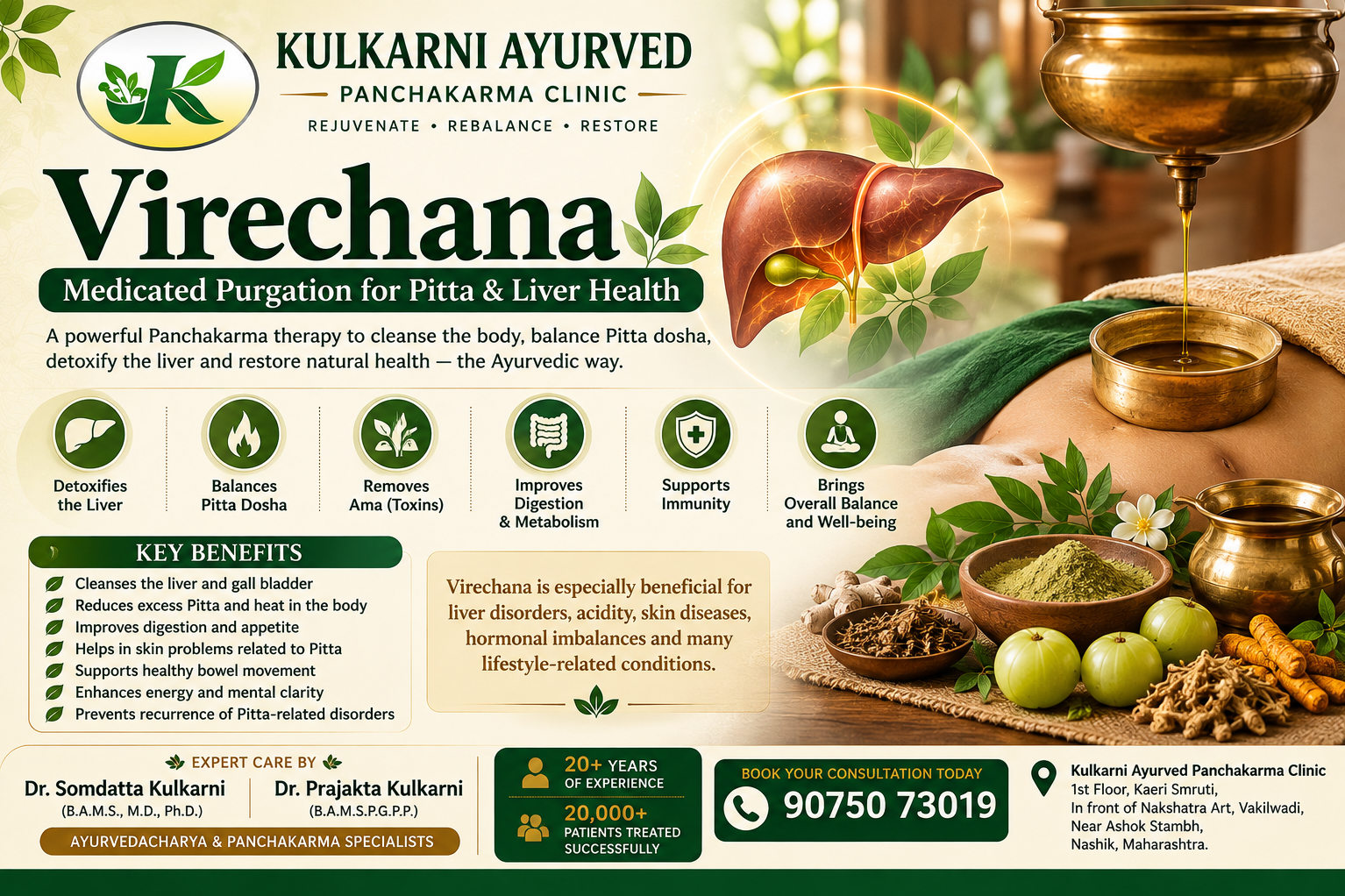
What is Virechana in Panchakarma? Dr. Somdatta & Dr. Prajakta Kulkarni explain how medicated purgation detoxes the liver, balances Pitta, and treats diabetes, skin disorders, PCOD & fatty liver — naturally. Best Panchakarma centre in Nashik. Of the five Panchakarma therapies, Virechana is the one most patients are initially nervous about — and the one most patients are most grateful for, once it is done. In over 20 years of clinical practice at KULKARNI AYURVED PANCHAKARMA CLINIC, Nashik, we have performed Virechana for hundreds of conditions — from diabetes and skin disorders to PCOD, fatty liver, migraines, and chronic acidity. And time after time, patients tell us the same thing after their Virechana is complete: 'Doctor, I feel lighter than I have felt in years.' That feeling is real. It is not just emotional relief. It is the physical result of the liver — your body's primary metabolic and hormonal processing organ — being freed from years of accumulated toxins and allowed to do its job properly again. In this blog, we explain exactly what Virechana is, how it works, what it treats, and what to expect — so that if Virechana is part of your Panchakarma programme, you know precisely what is happening and why. In This Article 1. What Is Virechana? — A Simple, Clear Explanation 2. Understanding Pitta — Why It Needs Its Own Cleansing Therapy 3. The Liver in Ayurveda — The Seat of Pitta and Metabolic Fire What Conditions Does Virechana Treat? 4. The Virechana Procedure — What Happens Step by Step Purvakarma — The Critical Preparation Before Virechana Samsarjana Krama — Post-Virechana Dietary Protocol 5. Virechana vs Other Liver Cleanses — How It Is Different 6. Benefits of Virechana Therapy 7. Who Should NOT Have Virechana? 8. Why Choose KULKARNI AYURVED PANCHAKARMA CLINIC, Nashik? 9. Frequently Asked Questions 1. What Is Virechana? — A Simple, Clear Explanation The word Virechana comes from the Sanskrit root 'Virechaka' — meaning to cause purging or elimination. In Panchakarma, Virechana is a medically supervised, specifically prepared herbal purgation therapy — a controlled elimination through the lower digestive tract that removes accumulated Pitta toxins from the liver, gallbladder, small intestine, and blood. It is critically important to understand what Virechana is NOT. It is not a simple laxative. It is not a colonic irrigation. It is not a juice cleanse or a detox diet. Virechana is a precisely calibrated medical procedure in which: - The body is prepared over 3 to 7 days through specific oleation and steam therapies to loosen Pitta toxins from the deep tissues and mobilise them into the digestive tract - A specific medicated purgation preparation — chosen and dosed individually by the doctor based on your body type, condition, and state of preparation — is administered - Controlled, graded elimination occurs — not violent or distressing, but systematic and therapeutically directed - The number of purgations is counted and monitored by the doctor as a measure of the depth and completeness of cleansing - A specific post-treatment dietary programme (Samsarjana Krama) restores digestive strength safely 'Pittam Virechanaat Shuddhyati — Pitta is purified through Virechana.' — Charaka Samhita, Kalpa Sthana This is the foundational principle: just as Basti is the primary treatment for Vata, and Vamana is the primary treatment for Kapha, Virechana is the primary Panchakarma treatment for Pitta disorders. Because Pitta governs metabolism, digestion, hormonal processing, skin health, the liver, and inflammatory responses — Virechana has an extraordinarily wide range of therapeutic applications. 2. Understanding Pitta — Why It Needs Its Own Cleansing Therapy In Ayurveda, Pitta dosha is the energy of transformation. It governs everything that involves heat, processing, and conversion in the body — the digestion of food, the metabolism of hormones, the processing of emotions, and the response to inflammation and infection. When Pitta is balanced, you feel sharp, warm, motivated, and healthy. When Pitta accumulates and becomes aggravated — through excess heat, spicy and fried food, alcohol, stress, anger, late nights, or inflammatory states — it overflows from its primary seat (the liver and small intestine) into the blood, skin, eyes, and other organs, causing a very specific range of disorders. Signs that your Pitta is aggravated and Virechana may be needed - Chronic acidity, acid reflux, or GERD - Skin conditions — acne, rosacea, eczema, urticaria, psoriasis - Yellowish tinge to the skin or eyes (mild jaundice) - Excessive heat sensation in the body, burning in hands and feet - Frequent anger, irritability, or emotional volatility - Migraine headaches — particularly those triggered by heat, skipped meals, or stress - High cholesterol, elevated liver enzymes (SGPT/SGOT), or fatty liver diagnosis - Blood sugar and metabolic disorders — diabetes, insulin resistance - Heavy or irregular periods with dark blood or clots - Recurrent mouth ulcers, bleeding gums - Redness of the eyes, photosensitivity - Inflammatory joint conditions — gout (Vatarakta), rheumatoid arthritis (Amavata with Pitta component) If you recognise several of these patterns, Pitta is likely accumulated in your system — and Virechana is the most direct, effective, and lasting way to eliminate it. 3. The Liver in Ayurveda — The Seat of Pitta and Metabolic Fire The liver holds a position of extraordinary importance in both Ayurveda and modern medicine — and the two systems agree on this significance even while describing it differently. In Ayurveda, the liver is called Yakrit and is considered the primary seat of Ranjaka Pitta — the form of Pitta that produces blood, gives colour to the tissues, and governs the metabolic processing of all nutrients and substances the body absorbs. When Ranjaka Pitta is aggravated — through poor diet, excessive alcohol, long-term medication, environmental toxins, or chronic metabolic stress — the liver becomes congested, inflamed, and functionally impaired. In modern medicine, we know that the liver performs over 500 functions — including: - Processing all nutrients absorbed from the intestine Metabolising and eliminating drugs, alcohol, and environmental toxins - Converting T4 to active T3 (thyroid hormone activation) - Metabolising oestrogen and other reproductive hormones - Regulating blood glucose through glycogen storage and gluconeogenesis - Producing bile for fat digestion and cholesterol regulation - Synthesising proteins essential for immune function and blood clotting - This is precisely why Virechana — by deeply cleansing the liver — has such a wide range of effects. When the liver is cleared of Pitta toxins and Ama, all 500+ of its functions improve simultaneously. Blood sugar control improves, hormone metabolism normalises, skin clears, cholesterol reduces, thyroid hormone conversion improves, and inflammatory markers fall — all from the same treatment, because they all originate from the same organ. 4. What Conditions Does Virechana Treat? Virechana is the most versatile of all Panchakarma therapies — because Pitta's influence touches so many organ systems. At KULKARNI AYURVED PANCHAKARMA CLINIC, Nashik, Virechana is a central component of our treatment protocol for the following conditions: Metabolic and Liver Conditions - Type 2 Diabetes (Madhumeha) — Virechana is the primary Panchakarma treatment for diabetes; it restores liver-mediated insulin sensitivity and T4-to-T3 metabolic function - Fatty Liver (NAFLD) — clears the hepatic Ama that is causing liver fat accumulation; SGPT and SGOT typically normalise within 6 to 8 weeks - High Cholesterol (Hyperlipidaemia) — the liver is the primary site of cholesterol synthesis and clearance; Virechana corrects this process at the source - Metabolic Syndrome — addresses all components simultaneously: insulin resistance, liver dysfunction, inflammatory fat, and lipid imbalance - Obesity (liver-connected) — particularly for patients whose weight gain is linked to fatty liver, high triglycerides, and hormonal disruption Skin and Blood Conditions - Chronic acne and acne rosacea — blood-borne Pitta is the root cause of inflammatory acne; Virechana cleanses the blood directly - Eczema (Vicharchika) — particularly the weeping, inflammatory, Pitta-dominant type - Psoriasis (Kitibha / Sidhma) — combined with specific blood-purifying therapies - Urticaria and chronic hives — blood-borne Pitta causing hypersensitive skin reactions - Jaundice and liver inflammation — indicated after the acute phase has resolved Hormonal and Gynaecological Conditions - PCOD / PCOS — the liver metabolises oestrogen and androgens; Virechana restores this hormonal clearance, correcting the elevated androgen state of PCOD - Thyroid disorders — restores liver-based T4 to T3 conversion; essential in hypothyroidism where liver dysfunction is a key factor - Heavy or irregular periods — particularly with dark blood, clots, and PMS — signs of blood and Pitta imbalance corrected by Virechana - Infertility linked to hormonal toxin load — cleansing the liver of hormonal Ama creates the clean hormonal environment needed for conception Gastrointestinal Conditions - Chronic acidity and acid reflux (GERD) — directly reduces excess Pitta in the stomach and small intestine - Irritable Bowel Syndrome (IBS) with diarrhoea or burning — Pitta-dominant IBS is excellently managed by Virechana - Constipation linked to liver congestion — bile insufficiency from liver congestion causes constipation; Virechana restores bile flow - Haemorrhoids (Arsha) with bleeding — Pitta-type haemorrhoids respond well to Virechana Neurological and Inflammatory Conditions - Migraine headaches — particularly those triggered by heat, stress, or skipped meals; Pitta-type migraines respond dramatically to Virechana - Gout (Vatarakta) — excess uric acid is cleared through the liver; Virechana provides significant and often rapid relief - Inflammatory arthritis — reduces the systemic inflammatory burden that drives joint inflammation - Epilepsy and mental health conditions with Pitta component — part of a comprehensive Ayurvedic neurological protocol 5. The Virechana Procedure — What Happens Step by Step Many patients are anxious about Virechana before they experience it. Here is exactly what happens — in simple, honest detail — so there are no surprises. Day 1 to 5 to 7 — Purvakarma (Preparation) Virechana cannot be performed without thorough preparation. The body must first be prepared through full-body oleation and steam so that the Pitta toxins are fully mobilised from the deep tissues into the digestive tract — from where Virechana can then eliminate them. Without this preparation, Virechana would only cleanse the intestinal contents, not the deep-seated Pitta in the liver, blood, and tissues. Full preparation details are in Section 6 below. The Evening Before Virechana The night before Virechana day, the patient eats a simple, light dinner — typically warm rice and dal. No heavy, fried, or cold food. Early bedtime is advised. Some preparations require the medicated Virechana drug to be given the night before; others require it to be given fresh in the morning. Your doctor will advise you specifically. 5. The Virechana Procedure — What Happens Step by Step Many patients are anxious about Virechana before they experience it. Here is exactly what happens — in simple, honest detail — so there are no surprises. Day 1 to 5 to 7 — Purvakarma (Preparation) Virechana cannot be performed without thorough preparation. The body must first be prepared through full-body oleation and steam so that the Pitta toxins are fully mobilised from the deep tissues into the digestive tract — from where Virechana can then eliminate them. Without this preparation, Virechana would only cleanse the intestinal contents, not the deep-seated Pitta in the liver, blood, and tissues. Full preparation details are in Section 6 below. The Evening Before Virechana The night before Virechana day, the patient eats a simple, light dinner — typically warm rice and dal. No heavy, fried, or cold food. Early bedtime is advised. Some preparations require the medicated Virechana drug to be given the night before; others require it to be given fresh in the morning. Your doctor will advise you specifically. Virechana Morning — Administration Virechana is performed in the morning, on an empty stomach. You come to KULKARNI AYURVED PANCHAKARMA CLINIC, Nashik at the appointed time. The doctor assesses your preparation — through pulse examination and clinical assessment — to confirm that the body is adequately prepared and ready for Virechana. If preparation is insufficient, the doctor may advise one more day of preparation rather than proceeding. Your safety and the therapeutic outcome always take precedence over the schedule. The medicated Virechana preparation — which has been individually formulated and dosed by your doctor based on your body weight, constitution, and condition — is given with warm water. You rest comfortably at the clinic. The Elimination Phase Within 1 to 3 hours, the medicated preparation begins to act. Controlled purgation occurs — the number, consistency, and character of the purgations are observed and counted by the supervising doctor or trained therapist. In Ayurveda, the number of purgations achieved is a measure of the degree of Pitta cleansing. The classical texts describe ideal, moderate, and minimal Virechana based on purgation count — and your doctor will assess which category you fall in and whether any further management is needed. The process is typically complete within 3 to 6 hours. It is not violent or distressing when properly prepared. Most patients describe it as graded and manageable — more like a strong but controlled clearing than a crisis. Warm water and specific herbal teas are given throughout to support the process and maintain hydration. Post-Virechana Assessment and Rest Once the elimination is complete, the doctor performs a final assessment — pulse, appearance, symptoms — to confirm that adequate and appropriate cleansing has been achieved. You then rest at the clinic for 1 to 2 hours. A specific warm diet (typically thin warm rice water or Peya — diluted rice gruel) is given before you leave. You spend the rest of the day resting at home. The Day After Virechana Most patients feel remarkably light, clear-headed, and well after the day of rest following Virechana. The skin often looks clearer, digestion feels lighter, energy improves, and many patients report their best sleep in months on the night of Virechana. Specific dietary and activity guidelines are followed for the next 3 to 7 days — the Samsarjana Krama phase — which is critical to consolidate the therapeutic benefit and restore digestive strength safely. 6. Purvakarma — The Critical Preparation Before Virechana Purvakarma — the pre-treatment preparation phase — is arguably as important as the Virechana itself. Virechana without adequate Purvakarma is like trying to wash a garment that has not been soaked. The toxins remain in the deep tissues and are not effectively eliminated. At KULKARNI AYURVED PANCHAKARMA CLINIC, Nashik, Purvakarma for Virechana consists of two essential components: Snehana — Internal and External Oleation Internal Snehana: Medicated ghee preparations are given internally in increasing doses over 3 to 7 days. This is one of the most distinctive aspects of classical Virechana preparation — and one that most poorly-conducted Virechana programmes skip, to their detriment. Internal ghee has a deep penetrating quality in Ayurveda (Sukshma and Vyavayi properties) that allows it to reach the deepest tissues — the liver, the blood, the hormonal glands — and loosen the Pitta toxins from these sites, bringing them into the digestive tract for elimination by Virechana. The dose is increased systematically each day until signs of adequate internal oleation appear (lightness, shine of skin, easy digestion of ghee without heaviness) — confirming the body is ready for the next phase. External Snehana (Abhyanga): Full-body warm medicated oil massage applied to the entire body daily throughout the preparation phase. Works synergistically with internal Snehana to mobilise peripheral and skin-level Pitta toxins, nourish the tissues being cleansed, and relax the body in preparation for the main procedure. Swedana — Full-Body Medicated Steam Full-body medicated herbal steam for the whole body is administered daily after Abhyanga throughout the preparation phase. The heat of the steam dilates the skin channels, drives mobilised toxins from the superficial tissues into the central digestive channels, and further softens and loosens the Pitta accumulation in the liver and intestinal tract. After a proper Purvakarma combining Snehana and Swedana over 3 to 7 days, the body is saturated with medicated oil and the Pitta toxins are fully concentrated in the digestive system — ready for effective elimination through Virechana. At KULKARNI AYURVED PANCHAKARMA CLINIC, Nashik, we never skip or shorten the Purvakarma phase. The thoroughness of preparation is what distinguishes a therapeutically effective Virechana from one that merely produces purgation without deep tissue cleansing. Every day of preparation is an investment in the depth and lasting quality of the result. 7. Samsarjana Krama — The Post-Virechana Dietary Protocol Samsarjana Krama is the post-Virechana dietary protocol — and it is one of the most important aspects of the entire programme. After Virechana, the digestive system has been deeply cleansed and its Agni (digestive fire) has been reset to a sensitive, almost newborn state. Eating the wrong food at this stage can cause significant digestive disruption and negate the therapeutic benefit. Eating the right food in the right progression rebuilds Agni safely and allows the body to absorb the full therapeutic benefit of the cleansing. The Samsarjana Krama follows a specific progression over 3 to 7 days — reintroducing foods in order of digestive complexity: Day 1 (day of Virechana): Peya — very thin, watery rice gruel; very small amounts; the most easily digestible food in Ayurveda Day 2: Vilepi — slightly thicker rice gruel; still very easy to digest; warm and simple Day 3: Akrita Yusha — thin moong dal water or vegetable soup without added spices Day 4: Krita Yusha — moong dal soup with mild, digestive spices (cumin, coriander); small portions Day 5: Thin Khichadi — rice and moong dal cooked together with mild spices; a small amount of ghee may be added Day 6 and 7: Gradual reintroduction of normal food — vegetables, dal, roti — in increasing quantities as Agni strengthens During Samsarjana Krama, the following are strictly avoided: cold food and drinks, heavy non-vegetarian food, fried items, raw salads, sour or spicy food, alcohol, and excessive exertion. Sexual activity and excessive talking or emotional stress are also advised against during this period in classical Ayurveda. Most patients find the Samsarjana Krama phase remarkably easy to follow — because after Virechana, their appetite naturally adjusts to lighter food and their body guides them intuitively towards the simpler diet. The craving for heavy, rich, or spicy food typically reduces dramatically after Virechana — a sign that the Pitta imbalance driving those cravings has been corrected. 8. Virechana vs Other Liver Cleanses — How It Is Different The internet is full of 'liver cleanses, ' detox juices, and gallbladder flushes. Patients often ask us how Virechana differs. Here is an honest, clear comparison: Virechana (Panchakarma)- Supervision- Medically supervised throughout by a qualified Ayurvedic doctor; pulse diagnosis, preparation assessment, procedure monitoring Juice Cleanses / Liver Detox Supplements- Self-administered without medical assessment or supervision Preparation Virechana (Panchakarma)- 3 to 7 days of systematic oleation (internal + external) and steam — essential for deep tissue cleansing Juice Cleanses / Liver Detox Supplements - None; work only on intestinal contents, not deep tissues Depth of cleansing Virechana (Panchakarma)-Reaches liver parenchyma, blood, lymph, and hormonal tissues — deep tissue Pitta removal Juice Cleanses / Liver Detox Supplements - Limited to intestinal tract and superficial metabolic change Personalisation Virechana (Panchakarma) - Individual assessment of body type, condition, and preparation state; individual dosing of preparation Juice Cleanses / Liver Detox Supplements - Generic; one formula for all body types and conditions The fundamental difference is this: Virechana is a medical procedure conducted by a doctor — with preparation, monitoring, dosing, and follow-up — not a wellness ritual or supplement programme. Its therapeutic depth and the objectivity of its measurable outcomes are in a completely different category. 9. Benefits of Virechana Therapy Here is what patients consistently experience at KULKARNI AYURVED PANCHAKARMA CLINIC, Nashik after a properly conducted Virechana programme: Immediate and early benefits (during and within 2 weeks) - Remarkable feeling of lightness throughout the body — 'I feel lighter than I have in years' is the most common description - Skin clears noticeably — acne reduces, redness diminishes, complexion brightens - Chronic acidity and burning sensation reduce significantly or disappear - Eyes become clearer and whiter — redness and sensitivity reduce - Sleep quality improves dramatically — often the best sleep in months on the night of Virechana - Appetite normalises — overpowering cravings for spicy, fried, or rich food reduce - Mental clarity improves — 'brain fog' reduces; thoughts feel cleaner and sharper - Irritability and anger reduce — emotional regulation improves noticeably Medium-term benefits (4 to 8 weeks) - Blood reports improve — SGPT and SGOT normalise in fatty liver patients; cholesterol reduces; fasting blood sugar and HbA1c fall in diabetic patients - Hormonal reports improve — FSH/LH ratio normalises in PCOD patients; testosterone reduces; thyroid conversion improves - Skin conditions continue to clear — chronic acne, eczema, and urticaria show significant improvement - Digestive function normalises — bloating, acidity, and bowel irregularity reduce - Migraines reduce in frequency and severity in Pitta-type migraine patients - Gout attacks reduce and uric acid levels begin to fall Long-term benefits (3 to 6 months and beyond) - Sustained hormonal balance — regular menstrual cycles, improved fertility outcomes, reduced menopausal symptoms - Sustained metabolic improvement — blood sugar and HbA1c maintain at improved levels; cholesterol remains controlled - Significant reduction or elimination of acne and chronic skin conditions - Improved liver function sustained — no recurrence of fatty liver if dietary guidelines are maintained - Emotional stability — reduced anger, irritability, and stress reactivity - Annual Virechana as preventive care maintains these benefits and prevents disease from accumulating again 10. Who Should NOT Have Virechana? Virechana is safe and beneficial for the vast majority of adults. However, it is contraindicated in certain conditions, and our doctors at KULKARNI AYURVED PANCHAKARMA CLINIC, Nashik assess every patient carefully before prescribing it. ⚠️ Important — Always consult a qualified Ayurvedacharya before starting Virechana or any Panchakarma therapy. At KULKARNI AYURVED PANCHAKARMA CLINIC, Nashik, every patient undergoes a thorough medical assessment — including Nadi Pariksha (pulse diagnosis) — before any treatment begins. Your safety is our first priority. Virechana is generally NOT advised for: - Pregnant women at any stage - Children below 7 years of age - Very elderly or severely debilitated patients - Patients with active acute infections, fever, or inflammatory bowel disease in a flare - Patients with very weak digestion (Ati-Mandagni) without adequate preparation - Patients with severe anaemia or very low body weight - Patients with advanced kidney disease (creatinine above 2.0 mg/dL) without modification - Patients who have not undergone adequate Purvakarma preparation — Virechana is never to be done without proper preparation - Patients with active bleeding disorders or those on blood thinners without careful assessment - Relative contraindications — where Virechana can be done with modifications and additional care — include: patients above 65 years, patients on multiple medications, patients with mild anaemia, patients with controlled cardiac conditions, and patients with previous gastrointestinal surgery. Our doctors will assess your specific situation and advise whether Virechana is appropriate as-is, with modification, or after additional preparation. 11. Why Choose KULKARNI AYURVED PANCHAKARMA CLINIC, Nashik? If you are searching for Virechana therapy in Nashik, Ayurvedic liver cleanse in Nashik, Pitta detox treatment in Nashik, or the best Panchakarma centre in Nashik for metabolic, skin, or hormonal conditions — here is why KULKARNI AYURVED PANCHAKARMA CLINIC is the right choice: - Classical, authentic Virechana protocol — we follow the complete classical procedure including thorough Purvakarma with internal and external Snehana and Swedana, individually dosed Virechana preparation, monitored elimination, and full Samsarjana Krama; we do not cut corners on any phase - 20+ years and 20, 000+ patients — Virechana is one of the most frequently performed procedures at our clinic; we have deep clinical experience in preparing, performing, and following up Virechana for a wide range of conditions - Two qualified specialists — Dr. Somdatta Kulkarni (B.A.M.S., M.D., Ph.D) and Dr. Prajakta Kulkarni (B.A.M.S.P.G.P.P.) personally assess and supervise every Virechana programme - Objective measurement — we track blood reports (SGPT, SGOT, cholesterol, blood sugar, HbA1c, hormones) before and after treatment so that improvements are measurably documented, not just reported as feelings - Integrative approach — we work alongside your existing physicians, gastroenterologist, dermatologist, or endocrinologist; our treatment complements your current medical care - Individually prepared medicines — the Virechana preparation used is chosen and dosed specifically for you; we never use a generic, off-the-shelf preparation for all patients - Conveniently located — 1st Floor, Kaveri Smruti, Vakilwadi, Near Ashok Stambh, Nashik 12. Frequently Asked Questions Is Virechana painful or distressing? When properly prepared and correctly administered, Virechana is not painful. The elimination that occurs is controlled and graded — it feels more like a strong, directed clearing than a crisis. Patients who have been adequately prepared with Snehana and Swedana consistently report that the process is much more manageable than they feared. The most common report from patients at KULKARNI AYURVED PANCHAKARMA CLINIC, Nashik is: 'It was nothing like I expected — I feel completely fine and remarkably light afterwards.' The day after Virechana is typically experienced as a day of exceptional wellbeing. How many times do I need to have Virechana? For most acute or moderate conditions, one well-conducted Virechana with full preparation is sufficient to provide significant therapeutic benefit. For chronic conditions — long-standing diabetes, chronic skin disorders, long-term fatty liver — a second course of Virechana may be recommended after 3 to 6 months once the system has been rebuilt. Additionally, annual Virechana as preventive maintenance (ideally in the autumn season, which is the classical time for Pitta cleansing in Ayurveda) is highly recommended for all patients — particularly those with Pitta constitution or Pitta-type chronic conditions. Can Virechana be done if I am on multiple medicines? Yes, in most cases. Our doctors review all your current medicines at the first consultation and assess any potential interactions or adjustments needed. The most important category to monitor is blood sugar medicines — as blood sugar often improves significantly after Virechana and doses may need to be reduced in consultation with your physician. Blood pressure medicines, thyroid medicines, and most other long-term medicines can be continued through the Virechana programme without significant concerns. Medicines that strongly affect gut motility may need adjustment — your doctor will advise you specifically. How is Virechana for PCOD different from just taking hormonal pills? Hormonal pills manage the symptoms of PCOD by introducing external hormones. Virechana treats a key root cause of PCOD — impaired liver metabolism of oestrogen and androgens. When the liver is congested with Ama, it cannot clear excess androgens (male hormones) from the bloodstream — which is why PCOD patients have elevated testosterone. Virechana cleanses the liver, restoring this clearance. The result is a natural fall in testosterone and androgens — which is reflected in reduced acne, reduced facial hair, and improved menstrual regularity — without the need for external hormonal supplementation. This is why Virechana is the most important single treatment in our PCOD protocol at KULKARNI AYURVED PANCHAKARMA CLINIC, Nashik. What is the cost of Virechana treatment at your Nashik clinic? The cost of Virechana depends on the duration of preparation (Purvakarma) required, the specific medicated preparations used, and any additional therapies in your programme. Please call us at 90750 73019 or visit KULKARNI AYURVED PANCHAKARMA CLINIC at 1st Floor, Kaeri Smruti, Vakilwadi, Near Ashok Stambh, Nashik for a detailed consultation and a transparent, complete cost estimate. We explain everything clearly before any treatment begins — no hidden charges and no obligation. Your Liver Deserves to Be Freed Years of metabolic burden, hormonal toxins, and dietary Ama have likely accumulated in your liver — silently affecting your blood sugar, your skin, your hormones, and your energy. Virechana is the single most powerful Ayurvedic therapy to set that right. At KULKARNI AYURVED PANCHAKARMA CLINIC, Nashik, we have seen it transform health in ways that surprise even us — after 20 years of doing this work. 📞 Call 90750 73019 | 💬 WhatsApp: 90750 73019 Free initial consultation · Classical Virechana protocol · 20+ Years Experience · KULKARNI AYURVED PANCHAKARMA CLINIC, Nashik