


2026-10-13T07:31:27
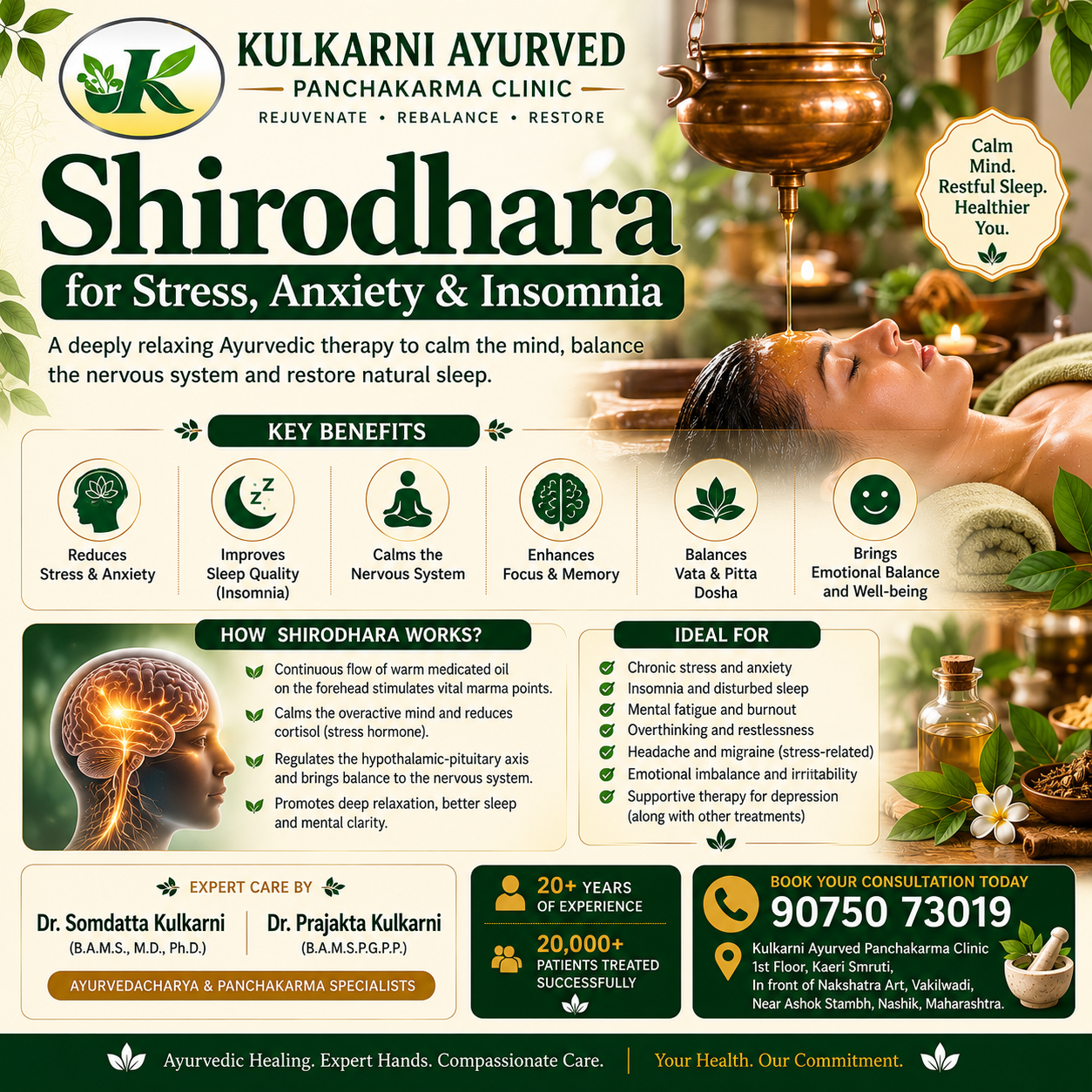
Struggling with stress, anxiety, or sleepless nights? Discover how Shirodhara — Ayurvedic Panchakarma therapy in Nashik — calms the nervous system, reduces cortisol, and restores deep sleep. Dr. Somdatta & Dr. Prajakta Kulkarni. Call 90750 73019. There is a particular kind of exhaustion that no amount of sleep seems to fix. The mind races at 2 AM. The body is tired but the thoughts will not stop. You wake up unrefreshed, carry the fatigue through the day, and by evening you are running on tension and caffeine — only to repeat the same sleepless night. At KULKARNI AYURVED PANCHAKARMA CLINIC, Nashik, this is one of the most common presentations we see — and it is getting more common every year. Stress, anxiety, and insomnia have become the defining health crisis of modern Indian urban life. And while modern medicine offers antidepressants, anxiolytics, and sleeping tablets — all of which have their place in crisis situations — they do not treat the underlying nervous system dysregulation that is driving the problem. They manage the symptoms while the root cause deepens. Shirodhara — one of the most remarkable and uniquely Ayurvedic of all Panchakarma therapies — does something entirely different. It directly and measurably calms the nervous system at its source, restores the body's own stress-regulating capacity, and allows the mind to return to its natural state of ease. In this blog, we explain exactly how — and why thousands of patients who visit us for Panchakarma in Nashik leave the Shirodhara table transformed. In This Article 1. What Is Shirodhara? — A Clear Explanation 2. The Science Behind Shirodhara — Why It Works 3. Stress, Anxiety, and Insomnia — The Ayurvedic Root Cause 4. What Conditions Does Shirodhara Treat? 5. Types of Shirodhara — Which One Is Right for You? 6. The Shirodhara Procedure — What Happens Step by Step 7. Shirodhara as Part of a Complete Panchakarma Programme 8. Shirodhara for Specific Conditions — Stress, Anxiety, Insomnia, PTSD, Burnout 9. What Results Can You Realistically Expect? 10. Who Should NOT Have Shirodhara? 11. Why Choose KULKARNI AYURVED PANCHAKARMA CLINIC, Nashik? 12. Frequently Asked Questions 1. What Is Shirodhara? — A Clear Explanation The word Shirodhara comes from two Sanskrit words — Shiro (head) and Dhara (flow or stream). It is an ancient Ayurvedic Panchakarma therapy in which a continuous, gentle stream of warm medicated liquid — usually medicated oil, but sometimes medicated buttermilk (Takra), decoctions, or milk — is poured in a slow, rhythmic flow over the centre of the forehead, specifically over the area between and slightly above the eyebrows. - This is not simply an oil pour. The specifics of Shirodhara are what make it therapeutically extraordinary: - The liquid flows from a specialised Dhara pot suspended at a precise height — producing a continuous, unbroken stream that contacts the forehead at a gentle, steady pressure - The pot swings gently from side to side in a slow, rhythmic arc — covering the entire forehead from temple to temple in a metronomic movement that becomes deeply hypnotic for the patient - The temperature is maintained at a precise therapeutic warmth — typically body temperature or slightly above — throughout the entire session - The session lasts 30 to 60 minutes — long enough for the profound neurological effects to develop fully - The patient lies completely still, eyes closed, in a deeply relaxed supine position - The result — which patients at KULKARNI AYURVED PANCHAKARMA CLINIC, Nashik describe with remarkable consistency — is a state of profound mental stillness that most of them have not experienced in months or years. Many fall into a deep, restful sleep on the table itself. Many describe the hour after Shirodhara as the most peaceful state of mind they have experienced as adults. This is not placebo. It is neurophysiology — and we explain exactly how it works in the next section. 2. The Science Behind Shirodhara — Why It Works Shirodhara works through several neurological and physiological mechanisms — all of which are now supported by modern research in addition to their classical Ayurvedic explanation: The forehead and the brain — a unique anatomical window The area of the forehead targeted by Shirodhara — the Ajna region between the eyebrows, corresponding to the frontal lobe and the limbic system beneath it — is one of the most neurologically significant areas of the human body. The skin of the forehead has an exceptionally high density of sensory nerve endings (particularly trigeminal nerve branches) that transmit directly to the brainstem and limbic system. The continuous, rhythmic sensory input of warm oil on this area produces measurable and profound effects on the brain's activity state. Activating the parasympathetic nervous system Modern stress and anxiety are fundamentally disorders of sympathetic nervous system overactivation — the 'fight or flight' system that modern life keeps permanently switched on. Shirodhara, through its continuous warm rhythmic stimulation of the forehead's trigeminal sensory field, activates the parasympathetic nervous system — the 'rest and digest' state — with a speed and depth that very few other interventions can match. Research studies on Shirodhara have documented significant reduction in heart rate, blood pressure, respiratory rate, and galvanic skin response — all objective markers of parasympathetic activation — within 20 to 30 minutes of beginning the procedure. Reducing cortisol — the stress hormone Chronic stress elevates cortisol — the primary stress hormone produced by the adrenal glands. Chronically elevated cortisol disrupts sleep (by elevating night-time cortisol that should normally be low), worsens anxiety (by sensitising the amygdala), impairs memory (by shrinking the hippocampus), causes weight gain (by promoting visceral fat storage), and worsens virtually every hormonal condition from thyroid to PCOD to diabetes. Clinical studies on Shirodhara have documented significant reduction in salivary and serum cortisol levels after a course of Shirodhara sessions — providing an objective, measurable basis for the profound stress reduction patients experience. Increasing serotonin and GABA The deep relaxation state produced by Shirodhara is associated with increased activity of serotonin (the 'calm and content' neurotransmitter) and GABA (the primary inhibitory neurotransmitter of the brain- Shirodhara appears to support the brain's own GABA system naturally — producing relaxation without dependency, without impaired cognitive function, and without the rebound anxiety and insomnia that sleeping pills cause when stopped. Synchronising brainwave activity Electroencephalography (EEG) studies on patients undergoing Shirodhara have shown a shift in brainwave activity from beta waves (the rapid, alert, anxious thinking state of a stressed mind) towards alpha waves (the relaxed, present, creative state of an unstressed mind) and even theta waves (the deeply meditative, pre-sleep state). This brainwave synchronisation is precisely what is missing in anxiety and insomnia — where the mind cannot shift down from beta-state activation even when the body desperately needs rest. The Ayurvedic explanation In Ayurveda, Shirodhara works by directly pacifying Vata in the mind and nervous system — specifically Prana Vata (the form of Vata governing the brain, sensory organs, and mental function) and Sadhaka Pitta (the form of Pitta governing emotional intelligence, clarity, and the heart-mind connection). The continuous warm oil flow nourishes and stabilises the Majja dhatu (nervous tissue), calms the overactive sensory channels, and restores the natural baseline of mental quietude that stress and anxiety have eroded. How modern life creates the Vata-stress spiral 1. Irregular sleep and wake times — the single most powerful Vata-aggravating behaviour; disrupts the circadian rhythm that governs every hormonal and neurological function 2. Screen exposure at night — blue light suppresses melatonin and keeps the nervous system in daytime-alert mode; Vata is inherently light and mobile, and night-time screen stimulation amplifies both 3. Constant digital stimulation — the endless scroll of news, social media, and messaging keeps the brain in perpetual beta-state; Vata's qualities of speed, movement, and variability are directly amplified by digital environments 4. Irregular meals or skipping meals — causes blood sugar instability that activates the stress hormone axis; each missed meal is a small cortisol spike that compounds over time 5. Overwork and multi-tasking — exhausts Prana Vata — the subtle nervous energy that governs the brain; depletes Ojas at the deepest level 6. Suppressing emotions — unexpressed grief, anger, fear, and loneliness accumulate as psychological Ama, disturbing Sadhaka Pitta and creating the emotional turbulence of anxiety 7. Chronic physical illness — any long-term condition (diabetes, PCOD, thyroid, arthritis) keeps the body in a low-grade stress state that continuously elevates Vata and depletes Ojas When this spiral runs long enough, the body loses its ability to self-regulate — to shift out of stress-state even when the stressor is removed. This is the state most chronic insomnia and anxiety patients are in when they arrive at KULKARNI AYURVED PANCHAKARMA CLINIC, Nashik. Shirodhara, as part of the Panchakarma programme, directly breaks this spiral at the neurological level. 4. What Conditions Does Shirodhara Treat? Shirodhara is one of the most versatile therapies in the Panchakarma toolkit — its effects on the nervous system, the stress-hormone axis, and the mind make it relevant for an extraordinary range of conditions. At KULKARNI AYURVED PANCHAKARMA CLINIC, Nashik, Shirodhara is a core treatment for the following: Mental health and nervous system conditions - - Chronic stress and burnout — particularly work-related, caregiving-related, or chronic illness-related exhaustion - Anxiety disorders — generalised anxiety, social anxiety, health anxiety, performance anxiety - Insomnia and sleep disorders — difficulty falling asleep, difficulty staying asleep, early waking, unrefreshing sleep - Depression — particularly the low-energy, anhedonic, disconnected type; Shirodhara is supportive, not a replacement for professional psychiatric care - Post-Traumatic Stress (PTSD) — Shirodhara's deep parasympathetic activation is particularly helpful for nervous systems stuck in trauma-state hypervigilance - Panic attacks — as part of a complete Vata-pacifying Panchakarma programme - OCD and intrusive thoughts — supporting treatment; reduces the Vata-driven mental restlessness underlying these conditions Neurological conditions - - Migraine headaches — particularly stress-triggered and hormonal migraines; Shirodhara reduces the frequency and severity of attacks significantly - Tension headaches — often completely relieved within a single Shirodhara session - Tinnitus (ringing in ears) — Vata-type tinnitus responds well to Shirodhara combined with Nasya - Memory impairment and brain fog — cognitive function typically improves measurably after a course of Shirodhara - Vertigo and dizziness — particularly the Vata-type (not caused by inner ear infection or cardiovascular issues) - Parkinson's disease — supportive therapy; reduces tremor temporarily and improves sleep quality Hormonal and metabolic conditions — where stress is a key driver - PCOD / PCOS — cortisol-driven hormonal disruption; Shirodhara is a key component of the PCOD Panchakarma protocol - Thyroid disorders — the HPT (Hypothalamic-Pituitary-Thyroid) axis is exquisitely sensitive to stress; Shirodhara normalises this axis - Hypertension — stress-related high blood pressure; blood pressure reduction after Shirodhara is well documented - Diabetes — cortisol raises blood glucose; reducing cortisol through Shirodhara directly supports blood sugar management - Infertility — chronic stress suppresses the reproductive hormonal axis; Shirodhara reduces this cortisol-mediated reproductive suppression 5. Types of Shirodhara — Which One Is Right for You? Not all Shirodhara is the same. The type of liquid used in Dhara is selected by the doctor based on your specific condition, constitution, and the predominant dosha imbalance. At KULKARNI AYURVED PANCHAKARMA CLINIC, Nashik, the following types are used: Taila Dhara Warm medicated oil (specific type prescribed by doctor). it is used in Stress, anxiety, insomnia, Vata disorders, neurological conditions Takradhara - Medicated buttermilk (Takra). mostly used in Hyperthyroidism, Graves' disease, Pitta-dominant anxiety (with heat, irritability, anger), inflammatory skin conditions on scalp, it is Strongly cooling; primarily Pitta-reducing Ksheera Dhara - Medicated milk . is is mostly used in Burning headaches, Pitta-type migraines, menopausal symptoms with heat and irritability, post-Virechana nourishment. it is Cooling and nourishing; Pitta-Vata balancing Kwatha Dhara- Herbal decoction. it is motly used in Specific neurological conditions; Kapha-dominant depression and lethargy; prescribed for specific conditions. The choice of Dhara liquid is a clinical decision made by the doctor after assessment — not a patient preference. Using the wrong type of Shirodhara for your constitution can reduce its effectiveness or, in some cases, aggravate the underlying imbalance. This is one of the most important reasons to have Shirodhara at a qualified Panchakarma clinic in Nashik with experienced doctors — not at a generic spa or wellness centre where the same oil is used for every patient regardless of condition. 6. The Shirodhara Procedure — What Happens Step by Step Here is exactly what to expect at KULKARNI AYURVED PANCHAKARMA CLINIC, Nashik during a Shirodhara session — so there are no surprises and you can fully relax into the experience: Before the session — consultation and preparation Your doctor reviews your condition, symptoms, sleep patterns, stress history, current medicines, and any relevant reports. Nadi Pariksha (pulse diagnosis) is performed to determine your doshic profile and the specific Dhara type and medicated preparation most appropriate for you. You are advised to come well-rested (not sleep-deprived the night before if possible), on a light stomach (not immediately after a heavy meal), and in comfortable, loose clothing. ⚠️ Important: Always consult a qualified Ayurvedacharya before starting Shirodhara or any Panchakarma therapy. At KULKARNI AYURVED PANCHAKARMA CLINIC, Nashik, every patient undergoes a thorough medical assessment — including Nadi Pariksha (pulse diagnosis) — before any treatment begins. Your safety is our first priority. Abhyanga — full-body warm medicated oil massage Shirodhara is always preceded by full-body Abhyanga — warm medicated oil massage applied to the entire body. This is not optional and is never skipped at KULKARNI AYURVED PANCHAKARMA CLINIC, Nashik. The Abhyanga prepares the nervous system and all body tissues for the deeper action of Shirodhara — warming and opening the Srotas (channels), reducing peripheral Vata tension, and beginning the process of nervous system settling that Shirodhara then deepens dramatically. Many patients are already in a deeply relaxed state by the time Abhyanga is complete — before Shirodhara even begins. Positioning and preparation You lie comfortably on your back on the wooden Droni (treatment table). A protective cotton band is placed across the hairline to prevent oil from entering the eyes. A small cotton ball may be placed in each ear for comfort. A rolled towel supports the neck. The treatment room is quiet, gently lit, and warm — the environment itself is designed to support the nervous system calming that Shirodhara produces. The Shirodhara — 30 to 60 minutes The specially prepared medicated liquid — warmed to the precise therapeutic temperature — is placed in the Dhara pot suspended above the forehead at the correct height. The therapist begins the flow — a continuous, unbroken, gently swinging stream of warm liquid that contacts the forehead at the exact centre, then moves rhythmically from temple to temple in a slow arc. The sound of the flowing liquid, the warmth, and the rhythmic movement combine to produce an experience that most patients describe as immediately and profoundly calming — often within the first 5 to 10 minutes. The session typically lasts 30 to 45 minutes for a standard session and up to 60 minutes for intensive therapeutic courses. Post-Shirodhara rest After Shirodhara, you rest quietly on the table for 10 to 15 minutes. Many patients are in a deeply relaxed or lightly sleeping state at this point and are allowed to rest fully before gently returning to wakefulness. You are then guided to a seated position slowly — standing up too quickly can occasionally cause a brief light-headedness from the profound blood pressure and heart rate reduction that Shirodhara produces. You rest in the clinic for 15 to 20 minutes before leaving. Driving is not recommended immediately after the session — arrange transport or rest for 30 minutes before driving. After the session The medicated oil is left on the scalp and hair for as long as practical — ideally 1 to 2 hours — before a warm (not hot) water wash. Cold water on the head is avoided on the day of Shirodhara. Avoid direct air conditioning or cold wind on the head for several hours. A light, warm meal is taken. Most patients sleep unusually deeply on the night of a Shirodhara session — this is the therapeutic effect working at its best and should be welcomed and supported. 7. Shirodhara as Part of a Complete Panchakarma Programme A single Shirodhara session produces remarkable results — and many patients at KULKARNI AYURVED PANCHAKARMA CLINIC, Nashik come for periodic individual sessions as maintenance. However, for patients with established anxiety disorders, chronic insomnia, burnout, or significant stress-related health conditions, Shirodhara as part of a complete Panchakarma programme produces far deeper and more lasting results than individual sessions alone. A complete Panchakarma programme for stress, anxiety, and insomnia at KULKARNI AYURVED PANCHAKARMA CLINIC, Nashik typically includes: 1. Daily Abhyanga — full-body warm medicated oil massage to the entire body; the foundation of nervous system nourishment 2. Full-body Swedana — medicated herbal steam for the whole body; complements Abhyanga and prepares the system for deeper treatments 3. Daily or every-other-day Shirodhara — the centrepiece of the stress and anxiety protocol; 7 to 21 sessions for a complete course 4. Nasya — medicated nasal drops; works directly on the hypothalamic-pituitary axis and the olfactory-limbic pathway; the fastest route to calming an anxious mind through the nasal passage's direct connection to the brain 5. Shiro Abhyanga — specific medicated head massage before Shirodhara; nourishes the scalp nerves, improves cerebral circulation, and deeply relaxes the scalp tension that most stressed patients carry 6. Pada Abhyanga — medicated foot massage; the feet contain a dense concentration of Vata-governing nerve endings; foot massage at bedtime is one of the most effective simple practices for insomnia 7. Basti karma — for patients where Vata imbalance has deep systemic roots; the colon is the primary seat of Vata and Basti directly corrects the source of the Vata disturbance driving the mental symptoms 8. Herbal medicines — prescribed after thorough examination of the patient; continued until the desired results of calm, sleep normalisation, and stress resilience are achieved The total programme duration for stress, anxiety, and insomnia conditions is typically 14 to 21 days of daily sessions, followed by herbal medicines for 1 to 3 months. The results — both immediately during the programme and in the months following — are consistently among the most transformative that patients at KULKARNI AYURVED PANCHAKARMA CLINIC, Nashik experience. 8. Shirodhara for Specific Conditions — Stress, Anxiety, Insomnia, Burnout Chronic Stress and Occupational Burnout The patient who has been working 12-hour days for years, whose body has forgotten what rest feels like, whose enjoyment of life has been replaced by a persistent numbness — this is Ojas depletion. The treatment focus is deep nourishment of the depleted nervous tissue (Majja dhatu) and restoration of Ojas through Shirodhara, Abhyanga, nourishing Basti, and specific Rasayana herbal preparations. Most burnout patients describe Shirodhara as 'the first time in years I felt my mind genuinely go quiet.' The programme typically spans 21 days for significant burnout, followed by lifestyle restructuring guidance. Anxiety — Generalised and Situational Anxiety in Ayurveda is the purest expression of aggravated Prana Vata — the rapid, scattered, fearful mental quality of Vata in excess. Shirodhara directly settles Prana Vata through its sustained warm rhythmic contact with the seat of the brain. Nasya complements Shirodhara by working on the hypothalamic-limbic pathway. Basti karma addresses the gut-anxiety connection that modern neuroscience now confirms — the gut's enteric nervous system and its microbiome are deeply implicated in anxiety disorders, and Basti heals this pathway. Most anxiety patients see significant reduction in both the frequency and the intensity of anxious episodes within 7 to 10 days of starting the complete programme. Insomnia — Difficulty Falling Asleep and Staying Asleep Insomnia has two primary Ayurvedic patterns — and the treatment differs for each: - Vata-type insomnia: difficulty falling asleep, racing thoughts, physical restlessness in the legs, anxiety about sleep itself; often worse in autumn and early winter; Taila Dhara (warm medicated oil Shirodhara) is the primary treatment - Pitta-type insomnia: falls asleep but wakes at 1 to 3 AM with a hot, mentally active state; vivid or disturbing dreams; anger or frustration about sleep; Takradhara or Ksheera Dhara is more appropriate for this pattern - For both types, Pada Abhyanga (medicated foot massage) at bedtime and Nasya in the morning are essential daily practices. Most insomnia patients at KULKARNI AYURVED PANCHAKARMA CLINIC, Nashik report significant improvement in sleep onset and sleep continuity within 5 to 7 sessions of Shirodhara — and normalisation of sleep architecture within the complete 14 to 21 day programme. Post-Traumatic Stress and Hypervigilance Trauma keeps the nervous system permanently in threat-detection mode — the amygdala stays activated, cortisol stays elevated, and the body cannot drop into the parasympathetic rest state even in safe environments. Shirodhara's documented parasympathetic activation is uniquely effective for this pattern. The continuous, predictable, warm, non-threatening sensory input of the oil flow gives the nervous system repeated experience of safety — a form of somatic reconditioning that gradually, session by session, teaches the body that it is safe to relax. We treat trauma-related presentations with great sensitivity at KULKARNI AYURVED PANCHAKARMA CLINIC, Nashik and always in coordination with any ongoing psychological or psychiatric care. Stress-Related Migraines and Tension Headaches Shirodhara is one of the most effective treatments we use for chronic migraine — particularly stress-triggered and hormonal migraines. The mechanism is direct: Shirodhara reduces cortisol, calms the trigeminal nerve (the primary mediator of migraine pain), reduces cerebrovascular reactivity, and normalises the serotonin dysregulation that underlies migraine pathophysiology. Many patients who have been using triptans and painkillers for years achieve dramatic reduction in migraine frequency — from 3 to 4 attacks per month to 1 or fewer — after a course of Shirodhara-based Panchakarma therapy in Nashik at our clinic. 9. What Results Can You Realistically Expect? First session Profound mental quietness during the session — most patients describe this as unlike anything they have experienced before. Deep sleep on the table in many cases. The evening and night after the first session almost always show noticeably improved sleep quality. Many patients sleep 7 to 8 hours continuously for the first time in months. Sessions 2 to 5 The nervous system begins to re-learn the relaxed state. Day-time anxiety levels begin to reduce noticeably. The mental chatter quiets progressively. Morning energy improves. Most patients report that their anxiety is present but significantly less intense and shorter-lasting. Sessions 7 to 14 Consistent improvement in sleep onset time and sleep continuity. Stress resilience improves — the same situations that previously triggered anxiety or overwhelm are handled with noticeably more equanimity. Migraine frequency begins to reduce. Blood pressure normalises in hypertensive patients. Hormonal improvements begin in PCOD, thyroid, and fertility patients for whom stress was a key driver. Full course completion (14–21 sessions) Most patients describe a fundamental shift in their baseline mental state — from anxious and depleted to calm and resourced. Sleep is regular and restorative. Stress is manageable. Many patients report that they have not felt this well since before the stress period began. The effects are not just during the Shirodhara — they carry forward into daily life 3 to 6 months (with herbal medicines and lifestyle) Sustained mental wellbeing maintained. The new nervous system baseline is consolidated. Patients who continue the lifestyle practices learned during the programme maintain their results. Annual or bi-annual Shirodhara maintenance sessions — especially in autumn and spring — prevent re-accumulation of stress and Vata. An honest word from our doctors: Shirodhara is not a miracle cure for deep psychiatric conditions that require professional mental health care. If you are on antidepressants, anxiolytics, or sleeping tablets, we never advise stopping these without your psychiatrist's guidance. What Shirodhara does — consistently and measurably — is reduce the nervous system's stress burden to a level where the body's own healing and regulatory capacity can re-emerge. In many patients, this allows a gradual, supervised reduction in medication over time as their nervous system recovers its own resilience. In all patients, it significantly improves quality of life — and that, in itself, is profoundly meaningful. 10. Who Should NOT Have Shirodhara? Shirodhara is safe for the vast majority of adults. However, it is contraindicated or requires careful modification in the following situations: - Patients with open cuts, wounds, or active skin infections on the scalp or forehead - Patients with very high fever or acute infection - Patients with extremely low blood pressure (hypotension) — Shirodhara further reduces blood pressure and can cause fainting - Patients in the first trimester of pregnancy — the profound relaxation and hormonal effects require assessment; second and third trimester generally safe with appropriate oil choice - Patients with very severe depression requiring immediate psychiatric intervention — Shirodhara is supportive but not a crisis intervention - Patients with active alopecia areata or severe scalp conditions — the specific oil used may need modification - Patients immediately after Vamana (therapeutic emesis) — a rest period is required between these procedures These contraindications are one of the most important reasons to have Shirodhara at a qualified Panchakarma clinic in Nashik under a doctor's supervision — not at a spa where medical contraindications are not assessed. At KULKARNI AYURVED PANCHAKARMA CLINIC, Nashik, every patient's suitability is assessed by our doctors before any session begins. 11. Why Choose KULKARNI AYURVED PANCHAKARMA CLINIC, Nashik? If you are searching for Shirodhara in Nashik, stress treatment Panchakarma in Nashik, Ayurvedic anxiety treatment in Nashik, insomnia Panchakarma clinic in Nashik, or the best Panchakarma centre in Nashik for mental wellness — here is why KULKARNI AYURVED PANCHAKARMA CLINIC is the right choice: - 20+ years and 20, 000+ patients — Shirodhara is one of the most frequently performed therapies at our clinic; we have performed thousands of sessions across a wide range of stress, neurological, hormonal, and metabolic conditions - Medically supervised — always — every Shirodhara session at our clinic is preceded by a doctor's consultation and is performed under medical supervision; we are a Panchakarma clinic in Nashik, not a spa; your health assessment and safety come first - Individually prescribed liquid and oil — the Dhara preparation is chosen specifically for your condition and constitution after Nadi Pariksha; we never use a generic one-oil-for-all approach - Classical protocol observed — Abhyanga always precedes Shirodhara; this is non-negotiable in classical Ayurveda and at our clinic; skipping Abhyanga reduces the therapeutic depth of Shirodhara significantly - Two qualified specialists — Dr. Somdatta Kulkarni (B.A.M.S., M.D., Ph.D) and Dr. Prajakta Kulkarni (B.A.M.S.P.G.P.P.) personally assess and supervise all treatment programmes - Integration with broader Panchakarma — for patients with conditions beyond stress and anxiety (PCOD, thyroid, diabetes, migraines), Shirodhara is designed as part of a complete, integrated treatment programme that addresses all conditions simultaneously - Safe coordination with mental health care — we work alongside your psychiatrist or psychologist; Panchakarma complements, never conflicts with, professional mental health treatment - Conveniently located — 1st Floor, Kaveri Smruti, Near Nakshatra Art, Vakilwadi, Near Ashok Stambh, Nashik, Maharashtra 12. Frequently Asked Questions How many Shirodhara sessions do I need for anxiety or insomnia? For mild to moderate stress or occasional insomnia — a course of 7 sessions (ideally on consecutive or alternate days) produces significant and sustained improvement in most patients. For established anxiety disorders, chronic insomnia of more than 3 months, or significant burnout — a full course of 14 to 21 sessions is recommended for durable results. Single sessions are available for patients who want to experience Shirodhara or for periodic maintenance — but for therapeutic outcomes, a minimum course is always more effective than individual sessions. Our doctors will advise the appropriate course length based on your specific situation at your first consultation at KULKARNI AYURVED PANCHAKARMA CLINIC, Nashik. Will I fall asleep during Shirodhara? Many patients do — and this is considered a good therapeutic sign. Falling asleep on the Shirodhara table means the nervous system has successfully shifted from sympathetic (alert, stressed) to parasympathetic (rest) mode — which is the entire therapeutic goal. Some patients, particularly on their first session, stay in a deeply relaxed but wakeful state — a meditative, floating awareness that most describe as deeply pleasant and unfamiliar. Both responses are completely normal and therapeutically valid. As the course progresses, the nervous system's ability to achieve this relaxed state becomes easier and faster. How is Shirodhara at your clinic different from Shirodhara at a spa? This is an important question. Spa Shirodhara is typically a wellness experience — a relaxing treatment using a standard oil for all clients, performed by a therapist without medical training, without prior health assessment, and without clinical follow-up. It feels good, but its therapeutic depth is limited. Shirodhara at KULKARNI AYURVED PANCHAKARMA CLINIC, Nashik — a medical Panchakarma clinic in Nashik — is a clinically prescribed procedure: the doctor assesses your condition, selects the specific medicated preparation for your doshic profile and health condition, the session is preceded by Abhyanga, the procedure is performed by trained therapists under medical supervision, and the full therapeutic programme includes herbal medicines, dietary guidance, and follow-up. The depth and durability of the therapeutic outcome is in a completely different category. Can Shirodhara help if I have tried everything — meditation, therapy, sleep hygiene — and still cannot sleep? Yes — this is precisely the patient who benefits most dramatically from Shirodhara. Cognitive approaches to insomnia (CBT-I, sleep hygiene, meditation) are excellent and we recommend them — but they work through the mind. When the nervous system's stress dysregulation is deeply physiological — embedded in cortisol rhythms, autonomic nervous system imbalance, and neurotransmitter depletion — a somatic (body-level) intervention is needed. Shirodhara works directly on the nervous system's physiology, not through cognitive processes. It reaches the place that thinking and willpower cannot. This is why patients who have 'tried everything' consistently tell us that Shirodhara finally gave them what they had been searching for. I have migraines triggered by stress. Will Shirodhara help? Stress-triggered migraines are one of the conditions where Shirodhara produces some of the most consistent and gratifying results at KULKARNI AYURVED PANCHAKARMA CLINIC, Nashik. By reducing cortisol, calming the trigeminal nerve, and normalising the serotonin dysregulation underlying migraine pathophysiology, a course of Shirodhara typically reduces migraine frequency by 50 to 70% in compliant patients. It is combined with Nasya (for direct action on the trigeminal-nasal pathway) and dietary correction (identifying and eliminating food triggers from an Ayurvedic perspective). Most migraine patients also see significant improvement in sleep and anxiety — the common companions of chronic migraine — as part of the same programme. Can pregnant women have Shirodhara? Shirodhara in the second and third trimester of pregnancy — with appropriate selection of oil type by an experienced Ayurvedic doctor — is generally safe and can be deeply beneficial for pregnancy-related stress, anxiety, and sleep disorders. The first trimester requires careful assessment and caution. At KULKARNI AYURVED PANCHAKARMA CLINIC, Nashik, Dr. Prajakta Kulkarni, who specialises in women's health, Garbhasanskar, and pregnancy care, personally assesses all pregnant patients before prescribing any Panchakarma therapy. Please never have Shirodhara during pregnancy without prior assessment by a qualified Ayurvedic specialist. Your Mind Deserves to Rest — Truly Rest Stress, anxiety, and sleepless nights are not your permanent state. They are a signal that your nervous system needs restoration — not more willpower, not more medication, but deep, intelligent nourishment at the level of the nervous system itself. Shirodhara, at KULKARNI AYURVED PANCHAKARMA CLINIC — your trusted Panchakarma centre in Nashik — is that restoration. Come experience what it feels like when the mind finally, truly goes quiet. 📞 Call 90750 73019 | 💬 WhatsApp: 90750 73019 Free initial consultation · Personalised Panchakarma programme · 20+ Years Experience · KULKARNI AYURVED PANCHAKARMA CLINIC, Nashik