

2026-07-15T10:37:57
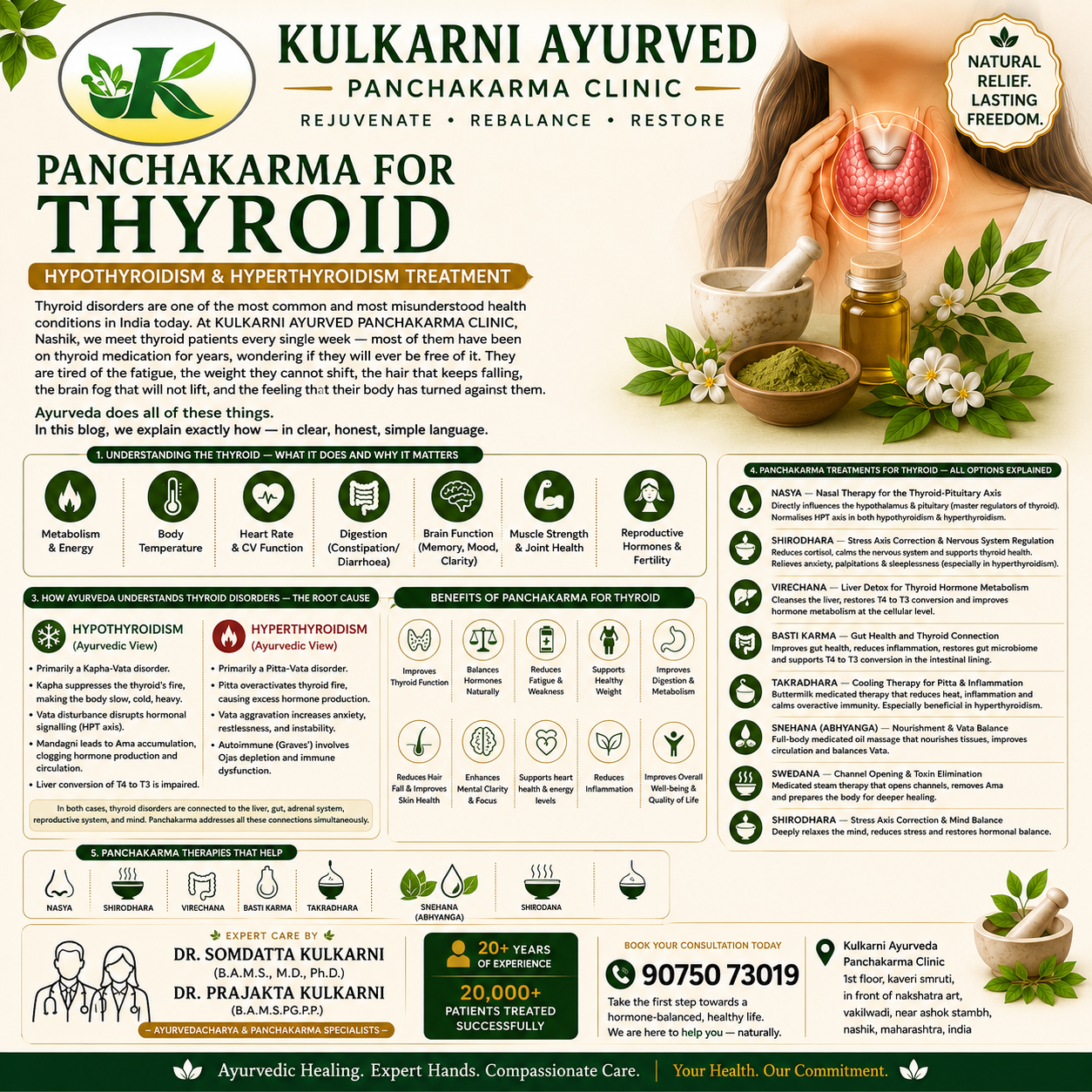
Struggling with thyroid disorders? Dr. Somdatta & Dr. Prajakta Kulkarni explain how Panchakarma treats hypothyroidism and hyperthyroidism naturally — reduce TSH, restore hormones, manage weight & fatigue. Best Panchakarma centre in Nashik. Call 90750 73019. Thyroid disorders are one of the most common and most misunderstood health conditions in India today. At KULKARNI AYURVED PANCHAKARMA CLINIC, Nashik, we meet thyroid patients every single week — most of them have been on thyroid medication for years, wondering if they will ever be free of it. They are tired of the fatigue, the weight they cannot shift, the hair that keeps falling, the brain fog that will not lift, and the feeling that their body has turned against them. We understand their frustration — because modern medicine's answer to thyroid disorders is often a single prescription: take this pill every morning for the rest of your life. That pill manages the numbers on your blood report. But it does not restore your thyroid's own function. It does not address the immune dysfunction in Hashimoto's. It does not correct the liver and gut issues that slow thyroid hormone conversion. And it does not fix the adrenal-thyroid connection that stress has damaged. Ayurveda does all of these things. In this blog, we explain exactly how — in clear, honest, simple language. In This Article 1. Understanding the Thyroid — What It Does and Why It Matters 2. Hypothyroidism vs Hyperthyroidism — What Is the Difference? 3. How Ayurveda Understands Thyroid Disorders — The Root Cause 4. Panchakarma Treatments for Thyroid — All Options Explained 5. The Complete Ayurvedic Thyroid Treatment Protocol 6. Hypothyroidism — Specific Treatment Approach 7. Hyperthyroidism — Specific Treatment Approach 8. Thyroid, Weight Gain, and Hair Loss — How Panchakarma Helps 9. Diet and Lifestyle for Thyroid Health — The Ayurvedic Approach 10. What Results Can You Realistically Expect? 11. Why Choose KULKARNI AYURVED PANCHAKARMA CLINIC, Nashik? 12. Frequently Asked Questions 1. Understanding the Thyroid — What It Does and Why It Matters The thyroid is a small, butterfly-shaped gland that sits at the front of your neck. It produces two primary hormones — T3 (triiodothyronine) and T4 (thyroxine) — that regulate virtually every metabolic process in your body. When you hear the word 'metabolism, ' think of the thyroid. It controls: How fast or slow your body burns energy (metabolic rate) Your body temperature and heat regulation Heart rate and cardiovascular function Digestive speed — constipation or diarrhoea often traces back here Brain function — memory, mood, and mental clarity Muscle strength and joint health Hair growth, skin quality, and nail strength Reproductive hormone balance — fertility, menstrual regularity, libido Weight regulation — one of the most metabolically active glands in the body In short, the thyroid is the master regulator of your body's pace. When it functions well, everything else tends to function well. When it goes off balance — even slightly — the effects ripple through every organ and system. This is why thyroid disorders cause such a wide, confusing array of symptoms that are often misdiagnosed or dismissed for years before the correct diagnosis is made. 2. Hypothyroidism vs Hyperthyroidism — What Is the Difference? There are two primary thyroid disorders that patients present with - Understanding the difference is important because their Ayurvedic treatment approaches are significantly different. What happens- Hypothroidism-Thyroid produces too little T3/T4. TSH rises as the pituitary tries to stimulate more production. Hyperthyroidism - Thyroid produces too much T3/T4. TSH falls as the pituitary tries to suppress overproduction. Common causes - Hypothyroidism - Hashimoto's thyroiditis (autoimmune), iodine deficiency, post-delivery (postpartum thyroiditis), medications Hyperthyroidism - Graves' disease (autoimmune), toxic nodular goitre, excess iodine, thyroid nodules Symptoms - Hypothyroidism -Weight gain, fatigue, cold intolerance, constipation, dry skin, hair loss, depression, brain fog, heavy periods, slow heart rate Hyperthyroidism - Weight loss, restlessness, heat intolerance, diarrhoea, rapid heart rate, anxiety, tremors, bulging eyes, light or absent periods Blood reports Hypothyroidism- High TSH, low T3/T4 Hyperthyroidism - Low TSH, high T3/T4 Most common in India Yes — hypothyroidism affects approximately 1 in 10 Indian women Hyperthyroidism -Less common — approximately 1 in 50 Both conditions also include subclinical forms — where TSH is slightly out of range but T3 and T4 are still normal — which Ayurveda is particularly good at treating before the condition progresses to full dysfunction. 3. How Ayurveda Understands Thyroid Disorders — The Root Cause In Ayurveda, the thyroid gland and its disorders are described in relation to a condition called Galaganda — swelling of the neck — and its metabolic and doshic correlates. The thyroid sits in the throat region, which in Ayurveda is governed by the Vishuddha chakra and is closely related to the functioning of Agni (metabolic fire) and the Kledaka Kapha (the moistening, lubricating form of Kapha that governs mucous membranes, glandular secretions, and metabolic fluids). Hypothyroidism — an Ayurvedic view Hypothyroidism is primarily a Kapha-Vata disorder. Excess Kapha — dense, cold, slow, and heavy in its qualities — suppresses the thyroid's fire (its capacity to produce hormones). Simultaneously, Vata disturbance disrupts the pulsatile hormonal signalling between the hypothalamus, pituitary, and thyroid gland (the HPT axis). The result is exactly what we see clinically — a slow, cold, heavy, sluggish state of the entire body and mind. Additionally, Mandagni (weak digestive fire) — which is both a cause and consequence of hypothyroidism — leads to accumulation of Ama (metabolic toxins) that further clog the channels of hormone production and circulation. The liver's ability to convert T4 to the active T3 is also impaired when Ama is present. Hyperthyroidism — an Ayurvedic view Hyperthyroidism is primarily a Pitta-Vata disorder. Excess Pitta — hot, sharp, penetrating, and metabolically active — overactivates the thyroid's fire, causing excess hormone production. This manifests as the heat, rapid heart rate, anxiety, inflammation, and metabolic overactivity that characterise hyperthyroidism. The autoimmune component (Graves' disease) involves Ojas depletion — a breakdown of the body's fundamental immunity and self-recognition, leading to the immune system attacking its own thyroid tissue. The deeper insight: In both cases, Ayurveda identifies that the thyroid disorder is never isolated. It is always connected to the health of the liver (which metabolises thyroid hormones), the gut (which is responsible for 20% of T4 to T3 conversion), the adrenal system (which shares the stress axis with the thyroid), the reproductive system (thyroid and reproductive hormones are deeply interdependent), and the mind (chronic stress is one of the most documented triggers of both hypo and hyperthyroidism). Panchakarma addresses all of these connections simultaneously — not just the thyroid gland in isolation. 4. Panchakarma Treatments for Thyroid — All Options Explained A Panchakarma programme for thyroid disorders at KULKARNI AYURVED PANCHAKARMA CLINIC, Nashik combines multiple therapies — each working at a different level of the thyroid-hormone-metabolic chain. Here is a complete explanation of each: ⭐ Nasya — Nasal Therapy for the Thyroid-Pituitary Axis Nasya is the administration of medicated oil or herbal preparations through the nostrils. It is one of the most important treatments for thyroid disorders and is almost always included in the thyroid Panchakarma protocol. The anatomical reason Nasya works so powerfully for the thyroid is this: the nasal passage provides a direct route to the base of the brain — where the hypothalamus and pituitary gland sit. These two glands are the master regulators of the thyroid. The hypothalamus produces TRH (thyrotropin-releasing hormone), which signals the pituitary to produce TSH (thyroid-stimulating hormone), which then signals the thyroid to produce T3 and T4. When this HPT (Hypothalamic-Pituitary-Thyroid) axis is dysregulated — as it is in both hypo and hyperthyroidism — Nasya directly influences and helps normalise it. For hypothyroidism, stimulating Nasya preparations are used to activate sluggish hypothalamic-pituitary signalling. For hyperthyroidism, cooling and calming Nasya preparations are used to reduce the overactivated axis. The specific medicine used in Nasya is chosen by the doctor based on your specific condition, constitution, and blood reports. ⭐ Shirodhara — Stress Axis Correction and Nervous System Regulation Continuous warm medicated oil flow on the forehead. The thyroid and the stress axis (HPA — Hypothalamic-Pituitary-Adrenal axis) are deeply interconnected. Chronic stress elevates cortisol, which directly suppresses the conversion of T4 to active T3, reduces TSH production, increases thyroid hormone-binding proteins (reducing free hormones), and triggers autoimmune thyroid disease (Hashimoto's and Graves') through immune dysregulation. Shirodhara is scientifically documented to significantly reduce cortisol levels, calm the sympathetic nervous system, and restore parasympathetic balance — thereby indirectly but powerfully supporting thyroid health. For patients with anxiety, heart palpitations, and sleeplessness due to hyperthyroidism, Shirodhara provides rapid and remarkable relief. ⭐ Virechana — Liver Detox for Thyroid Hormone Metabolism The liver plays a critical and often overlooked role in thyroid function. Approximately 60% of thyroid hormone conversion from T4 (inactive) to T3 (active) occurs in the liver. When the liver is congested with Ama and Pitta toxins — from poor diet, medications, alcohol, or metabolic sluggishness — this conversion is impaired. A person may have normal T4 levels on blood reports but suffer from hypothyroid symptoms because their liver is not converting T4 to active T3 effectively. Virechana deeply cleanses the liver, restoring this conversion pathway and making the available thyroid hormones actually effective at the cellular level. ⭐ Basti Karma — Gut Health and Thyroid Connection Modern research now confirms what Ayurveda has always understood — the gut and the thyroid are deeply connected. Approximately 20% of T4 to T3 conversion occurs in the intestinal lining. Gut dysbiosis, leaky gut, and intestinal inflammation all impair this conversion and contribute to autoimmune thyroid conditions (Hashimoto's involves gut permeability as a key mechanism). Basti karma — medicated enema therapy — directly treats the intestinal environment, reducing inflammation, correcting gut microbiome imbalance, and restoring the gut-thyroid hormone conversion pathway. ⭐ Snehana / Abhyanga — Full-Body Warm Medicated Oil Massage Full-body warm medicated oil massage applied to the entire body before every Panchakarma session. Specific medicated oils that support thyroid function are chosen for hypothyroid patients. This Purvakarma preparation mobilises Ama from the thyroid and surrounding tissues, nourishes the nervous system, and opens the channels through which thyroid hormones circulate to all body tissues. ⭐ Swedana — Full-Body Medicated Steam Full-body medicated herbal steam for the whole body. For hypothyroid patients, the warmth stimulates metabolic function and Agni — directly countering the cold, slow Kapha-dominant state. Opens skin channels for toxin elimination. Not used in hyperthyroidism where heat is already excessive — instead, cooling alternatives like Takradhara are employed. ⭐ Takradhara — For Hyperthyroidism and Hashimoto's A continuous flow of medicated buttermilk (Takra) over the forehead, replacing Shirodhara in patients for whom warm oil is contraindicated. Deeply cooling, anti-inflammatory, and calming to an overactive sympathetic nervous system. Particularly useful in hyperthyroidism, Graves' disease, and Hashimoto's with high inflammatory markers. ⭐ Lepa — External Thyroid Herbal Application Specific medicated herbal pastes (Lepa) applied externally to the neck and thyroid region. The herbs in these pastes penetrate the skin and act directly on the thyroid glandular tissue — reducing inflammation, supporting hormone synthesis, and in goitre cases, reducing the physical enlargement of the gland. 5. The Complete Ayurvedic Thyroid Treatment Protocol Here is how a complete Panchakarma thyroid treatment programme is structured at KULKARNI AYURVED PANCHAKARMA CLINIC, Nashik: Step 1: Detailed Consultation and Thyroid Assessment Your doctor reviews your complete symptom history, all thyroid blood reports (TSH, Free T3, Free T4, Anti-TPO antibodies, Anti-Tg antibodies), thyroid ultrasound, and any other relevant investigations. Nadi Pariksha (pulse diagnosis) is performed to assess the specific doshic imbalance driving your thyroid condition. A completely personalised treatment plan is designed — with specific therapies, their sequence, and duration. ⚠️ Important: Always consult a qualified Ayurvedacharya before starting Panchakarma. At KULKARNI AYURVED PANCHAKARMA CLINIC, Nashik, every patient undergoes a thorough medical assessment — including Nadi Pariksha (pulse diagnosis) — before any treatment begins. Your safety is our first priority. Step 2: Purvakarma — Preparation Phase (Days 1 to 5) Full-body Snehana (warm medicated oil massage to the entire body) and full-body Swedana (medicated herbal steam for the whole body — modified for hyperthyroid patients) are performed daily. Internal Snehana (medicated ghee) prepares and lubricates the deep tissues, mobilising Ama from the thyroid, liver, and gut — where thyroid dysfunction is rooted. Step 3: Pradhanakarma — Main Panchakarma Phase (Days 5 to 21) Nasya — daily sessions targeting the hypothalamic-pituitary-thyroid axis; the single most targeted treatment for thyroid regulation Virechana — deep liver cleansing to restore T4-to-T3 conversion; performed after adequate preparation Basti karma — gut healing and Vata regulation; Yoga Basti or Kala Basti based on severity Shirodhara or Takradhara — stress axis correction; Shirodhara for hypothyroidism and Hashimoto's; Takradhara for hyperthyroidism and Graves' Lepa — direct thyroid gland application where indicated Herbal medicines — prescribed after thorough examination of the patient; continued until the desired results are achieved Step 4: Paschatkarma — Post-Treatment Plan Herbal medicines prescribed after thorough examination of the patient and continued until desired thyroid function results are achieved. A detailed Ayurvedic diet plan, yoga and Pranayama recommendations, stress management protocols, and specific lifestyle guidelines are prescribed. Follow-up consultations at 30 days, 90 days, and 6 months — with repeat thyroid blood reports to objectively track improvement. 6. Hypothyroidism — Specific Treatment Approach Hypothyroidism — the more common of the two conditions, and particularly prevalent in women of reproductive age in Nashik and across Maharashtra — responds very well to Ayurvedic treatment. Here is the specific focus of our approach at KULKARNI AYURVED PANCHAKARMA CLINIC, Nashik: The primary goals in hypothyroid treatment - Stimulate thyroid hormone production — Nasya with specific stimulating preparations activates the hypothalamic signal to the thyroid - Improve T4 to T3 conversion — Virechana and herbal support for liver function - Reduce Kapha obstruction — Vamana (in high Kapha cases), Udwartana, and Lekhana herbs clear the Kapha that is suppressing thyroid activity - Correct gut-thyroid axis — Basti karma to heal the intestinal lining and restore the 20% gut-based T3 conversion - Address Hashimoto's autoimmune component — Rasayana (rejuvenative) herbs and Virechana reduce the autoimmune inflammation attacking the thyroid - Correct the weight and metabolic consequences — Udwartana, Lekhana Basti, and metabolic correction through Agni stimulation Connecting hypothyroidism and women's health At KULKARNI AYURVED PANCHAKARMA CLINIC, Nashik, we frequently see women who have both hypothyroidism and PCOD — as the two conditions share common metabolic roots (insulin resistance, liver dysfunction, gut dysbiosis, adrenal stress). Our treatment protocol addresses both conditions simultaneously — correcting the shared root causes rather than treating each in isolation. Many of our female patients see improvement in both their thyroid reports and their menstrual regularity from the same Panchakarma programme. 7. Hyperthyroidism — Specific Treatment Approach Hyperthyroidism and Graves' disease require a different treatment strategy — one that calms, cools, and reduces excessive thyroid activity rather than stimulating it. At KULKARNI AYURVED PANCHAKARMA CLINIC, Nashik, the specific focus for hyperthyroid patients is: The primary goals in hyperthyroid treatment - Reduce excess Pitta and thyroid overactivity — cooling Virechana (with Pitta-reducing preparations) is the primary cleansing therapy; Takradhara replaces Shirodhara for the calming effect without additional heat - Calm the autoimmune attack (Graves' disease) — Ojas-building Rasayana herbs, Virechana, and stress reduction through Takradhara reduce the autoimmune component - Regulate the overactivated nervous system — Basti karma with calming formulations, Nasya with cooling oils reduce the nervous system hyperactivation that drives rapid heart rate and anxiety - Protect the heart and cardiovascular system — specific herbs that reduce heart rate naturally and protect the cardiac muscle from the effects of excess thyroid hormones - Nourish depleted tissues — hyperthyroidism causes significant weight loss and tissue wasting; nourishing Basti preparations rebuild muscle and fat tissue safely - An important note on hyperthyroid patients: Patients with severe hyperthyroidism (very low TSH, very high T3/T4, significant cardiac symptoms) should always ensure their allopathic treatment is stabilised before beginning Panchakarma. Our doctors at KULKARNI AYURVED PANCHAKARMA CLINIC, Nashik will review your blood reports and current medicines carefully and advise whether Panchakarma is appropriate to begin immediately or after initial allopathic stabilisation. 8. Thyroid, Weight Gain, and Hair Loss — How Panchakarma Helps Two of the most distressing symptoms of hypothyroidism — and the ones that bring the most patients to KULKARNI AYURVED PANCHAKARMA CLINIC, Nashik — are weight gain and hair loss that do not respond even when the TSH numbers are 'controlled' by medication. Why thyroid weight does not respond to normal dieting When the thyroid is underactive, every metabolic pathway slows down. The body burns fewer calories at rest, holds more water, accumulates more fat — and ordinary calorie restriction makes it worse by further suppressing an already sluggish metabolism. Simply lowering calories does not address the hormonal metabolic dysfunction at the cellular level. Panchakarma addresses this through Udwartana (herbal powder massage to stimulate fat metabolism), Lekhana Basti (to clear metabolic obstruction), Virechana (to restore liver-thyroid hormone conversion), and systematic Agni correction (to rebuild the metabolic fire). Many of our hypothyroid patients who could not lose weight despite being on thyroid medication begin losing weight consistently after Panchakarma — because the real metabolic blocks have been removed. Why thyroid hair loss persists even on medication Hair follicles need adequate levels of active T3 — not just T4 — to maintain the hair growth cycle. Many patients on T4-only replacement (Thyroxine tablets) still experience hair loss because their T4-to-T3 conversion in the liver and gut remains impaired. Panchakarma — through Virechana, Nasya, and Basti — improves this conversion, increases the supply of active T3 to hair follicles, and supports scalp circulation through Abhyanga. Most patients notice visible improvement in hair thickness and reduction in hair fall within 8 to 12 weeks of completing the programme. 9. Diet and Lifestyle for Thyroid Health — The Ayurvedic Approach Panchakarma provides the deep internal correction — but diet and daily lifestyle are what maintain thyroid health long-term. At KULKARNI AYURVED PANCHAKARMA CLINIC, Nashik, every patient receives personalised guidance. Here are the general principles: For hypothyroidism — eat more of these - Warm, freshly cooked food — always; the thyroid needs warmth to function - Selenium-rich foods — Brazil nuts (2 daily), sunflower seeds, brown rice; selenium is essential for T4-to-T3 conversion - Zinc-rich foods — pumpkin seeds, legumes, sesame seeds; zinc is critical for thyroid hormone synthesis - Iodine from food sources — seaweed, seafood (if non-vegetarian), iodised salt in moderation - Ashwagandha and Brahmi as herbal teas — adaptogenic herbs that support thyroid function and reduce cortisol - Ginger, turmeric, black pepper — digestive spices that stimulate Agni and reduce Kapha obstruction For hypothyroidism — reduce or avoid these - Raw goitrogens in large quantities — raw cabbage, raw broccoli, raw cauliflower, raw kale — these contain substances that block iodine uptake and suppress thyroid function when eaten raw in large amounts. Cooking neutralises most of the goitrogenic effect, so cooked versions in normal quantities are fine. - Soy products in excess — isoflavones in soy can interfere with thyroid hormone synthesis - Cold, heavy, oily food — worsens Kapha and further slows the already sluggish thyroid - Gluten (if Hashimoto's is present) — significant research shows gluten triggers autoimmune thyroid flares in susceptible individuals; many of our Hashimoto's patients improve dramatically on a gluten-reduced diet - Taking thyroid medication with tea or coffee — reduces absorption significantly; always take on an empty stomach with plain water For hyperthyroidism — key dietary points - Cooling, anti-Pitta diet — coconut water, cucumber, coriander, pomegranate, sweet fruits - Avoid excess iodine — seaweed, iodine supplements, excessive iodised salt - Avoid stimulants — coffee, strong tea, energy drinks worsen palpitations and anxiety - Calcium and Vitamin D — excess thyroid hormones accelerate bone loss; ensure adequate intake Lifestyle essentials for both thyroid conditions - Take thyroid medication correctly — first thing in the morning on an empty stomach, 30 to 60 minutes before food and other medicines - Stress management is non-negotiable — daily Pranayama (especially Anulom Vilom and Bhramari) for 15 minutes significantly reduces cortisol and supports the HPT axis - Consistent sleep — sleep before 10:30 PM; thyroid hormone production peaks during deep sleep; irregular sleep directly disrupts thyroid rhythm - Yoga for thyroid health — Sarvangasana (shoulder stand), Matsyasana (fish pose), Halasana (plough pose), Ujjayi Pranayama — these specifically stimulate the thyroid region. Always practice under guidance; these are contraindicated in certain thyroid conditions. - Avoid iodine excess — both hypo and hyperthyroid patients should avoid sudden large doses of iodine from supplements, which can trigger thyroid crises 10. What Results Can You Realistically Expect? Here is an honest, realistic picture based on our 20+ years of experience at KULKARNI AYURVED PANCHAKARMA CLINIC, Nashik: During treatment (Days 1–21) - Improved energy levels and sleep quality. Reduction in brain fog and mood disturbances. Hypothyroid patients feel warmer and more energetic. Hyperthyroid patients feel calmer, with reduced palpitations and anxiety. 4 to 8 weeks after treatment- Thyroid blood reports begin to improve — TSH moves towards the normal range in hypothyroid patients; T3/T4 begins to reduce towards normal in hyperthyroid patients. Hair fall typically reduces noticeably. Skin quality improves. Constipation (hypothyroid) or diarrhoea (hyperthyroid) normalises. 3 to 6 months - Most patients who complete the full programme and follow the guidelines achieve TSH normalisation or significant improvement. Hypothyroid patients on medication typically find their physician is able to reduce their thyroxine dose. Weight begins to reduce sustainably in hypothyroid patients. Hair thickness improves visibly. 6 to 12 months - Anti-TPO antibodies (in Hashimoto's) reduce significantly in many patients. Some patients achieve complete thyroid function normalisation and are able to discontinue medication under their physician's supervision. This is not universal but is consistently achieved in a significant proportion of patients who are compliant. An honest word from our doctors: The thyroid, once significantly damaged by years of autoimmune attack (Hashimoto's) or long-term dysfunction, takes time to recover. We do not promise to cure every thyroid condition. What we do promise is this — we will identify and treat the actual root cause, improve your quality of life significantly, and in most cases, improve your thyroid numbers enough to reduce your medication dependence. That is our commitment to every patient at KULKARNI AYURVED PANCHAKARMA CLINIC, Nashik. 11. Why Choose KULKARNI AYURVED PANCHAKARMA CLINIC, Nashik? If you are searching for Ayurvedic thyroid treatment in Nashik, Nasya for thyroid in Nashik, natural hypothyroidism treatment in Nashik, or the best Panchakarma centre in Nashik for hormonal disorders — here is why KULKARNI AYURVED PANCHAKARMA CLINIC is the right choice: - 20+ years and 20, 000+ patients — including a large number of thyroid patients treated at every stage, from subclinical to severe dysfunction - Two qualified specialists — Dr. Somdatta Kulkarni (B.A.M.S., M.D., Ph.D) manages Panchakarma and metabolic aspects; Dr. Prajakta Kulkarni (B.A.M.S.P.G.P.P.) brings expertise in hormonal and gynaecological conditions, including the thyroid-PCOD-fertility connection - Objective tracking — we use your thyroid blood reports before and after treatment to objectively measure and demonstrate improvement; we never ask you to go by symptoms alone - Safe reduction of thyroid medication — we work alongside your endocrinologist and never advise abruptly stopping any thyroid medicine; we guide you on how to have the conversation with your doctor about gradual dose reduction as your reports improve - Hashimoto's and autoimmune expertise — beyond TSH management, we understand and treat the autoimmune component of thyroid disease that standard allopathic treatment often does not address - Conveniently located — 1st Floor, Kaeri Smruti, Vakilwadi, Near Ashok Stambh, Nashik 12. Frequently Asked Questions Can Ayurveda cure hypothyroidism permanently? For hypothyroidism caused by Hashimoto's (autoimmune), complete permanent cure depends on reducing the autoimmune attack on the thyroid — which Panchakarma and Ayurvedic medicines can achieve to a significant extent in many patients. For hypothyroidism caused by significant structural damage to the thyroid tissue (as seen after radioactive iodine treatment or thyroid surgery), restoration of full function may not be possible. However, even in these cases, Panchakarma significantly reduces the medicine dose needed and improves quality of life substantially. For subclinical hypothyroidism and early-stage Hashimoto's — the results of complete recovery with Ayurveda are very promising in our clinical experience. Can I continue my thyroxine (Thyronorm / Eltroxin) while undergoing Panchakarma? Yes, absolutely. We never advise stopping thyroid medication without the guidance of your prescribing doctor. Continue your thyroid medication as prescribed throughout the Panchakarma programme. As your thyroid function improves — which we track objectively through blood reports — your endocrinologist or physician will be able to gradually reduce your dose. This dose reduction is the proof that the treatment is working. At KULKARNI AYURVED PANCHAKARMA CLINIC, Nashik, we work alongside your medical team, not against them. How many sessions of Nasya are needed for thyroid treatment? In a standard Panchakarma thyroid programme, Nasya is typically given daily for 7 to 14 days during the main treatment phase. After the in-clinic programme, Nasya may be recommended as a home practice (Pratimarsha Nasya — 2 drops of specific medicated oil in each nostril daily) and as periodic monthly or seasonal clinic sessions to maintain the benefit. The specific duration and number of sessions are determined by your doctor based on your condition and blood report targets. My TSH is 8 — should I start thyroid medication or try Ayurveda first? A TSH of 8 with normal T3 and T4 is called subclinical hypothyroidism — and this is one of the situations where Ayurvedic treatment alone often gives excellent results, avoiding the need to start lifelong medication. Many endocrinologists also prefer a watchful waiting approach at this level rather than immediate medication. We would recommend consulting both your physician and our doctors at KULKARNI AYURVED PANCHAKARMA CLINIC, Nashik before making a decision. In our clinical experience, many patients in the TSH range of 5 to 10 have achieved complete normalisation through Panchakarma and Ayurvedic medicines alone, without ever needing to start allopathic thyroid medication. I have Hashimoto's thyroiditis with high Anti-TPO antibodies. Can Panchakarma help? Yes — and Hashimoto's is one of the conditions where Ayurveda has the most to offer. The autoimmune component of Hashimoto's — the immune system attacking thyroid tissue — is largely driven by gut permeability (leaky gut), adrenal-stress dysregulation, liver inflammation, and nutritional deficiencies. Panchakarma addresses all of these root causes. Our experience with Hashimoto's patients at KULKARNI AYURVED PANCHAKARMA CLINIC, Nashik consistently shows significant reduction in Anti-TPO and Anti-Tg antibody levels after 6 to 12 months of Ayurvedic treatment — reflecting genuine reduction of the autoimmune attack, not just management of its consequences. Can Panchakarma help with thyroid and fertility issues together? Yes — in fact, this combination is extremely common and extremely well-treated through Panchakarma at KULKARNI AYURVED PANCHAKARMA CLINIC, Nashik. Thyroid dysfunction — even subclinical hypothyroidism — is a major cause of ovulation problems, early miscarriage, and poor embryo implantation. When we correct thyroid function through Panchakarma, fertility often improves simultaneously. Our protocol for thyroid-related infertility combines the thyroid treatment approaches described in this blog with the reproductive Panchakarma therapies including Uttara Basti for uterine preparation. Please speak with Dr. Prajakta Kulkarni specifically for this combination. How is Panchakarma thyroid treatment different from just taking herbal thyroid supplements? Herbal thyroid supplements — even good quality ones — address only one dimension of thyroid dysfunction: they provide herbal support for hormone synthesis or conversion. Panchakarma is a complete system that removes the deep-rooted Ama blocking thyroid function, repairs the liver-gut-thyroid axis, corrects the stress-thyroid connection, addresses the autoimmune component, and then supports hormone production and conversion through herbal medicines. The difference in outcomes is significant and consistent. Supplements alone almost never achieve the degree of TSH normalisation and symptomatic recovery that a full Panchakarma programme achieves. What is the cost of Ayurvedic thyroid treatment at your Nashik clinic? The cost depends on the specific therapies prescribed, the duration of the programme, and your individual condition. Please call us at 90750 73019 or visit KULKARNI AYURVED PANCHAKARMA CLINIC at 1st Floor, Kaeri Smruti, Vakilwadi, Near Ashok Stambh, Nashik for a detailed consultation and a transparent cost estimate. We explain everything clearly before any treatment begins. Is Panchakarma safe for thyroid patients who are also taking other medicines? Yes — Panchakarma is safe alongside thyroid medication and most other medicines. Our doctors review all your current medicines at your first consultation. There are no known significant interactions between Panchakarma therapies and thyroid medicines. As always, we ask that you continue all prescribed medicines throughout the programme and reduce them only under the guidance of your prescribing doctor as your reports improve. Your Thyroid Can Heal — Naturally and Measurably Tired, foggy, gaining weight, losing hair — you deserve better than a lifetime on tablets without addressing the root cause. At KULKARNI AYURVED PANCHAKARMA CLINIC, Nashik, we help your thyroid heal from the inside out. Every step of the way, we track your blood reports so you can see the results for yourself. 📞 Call 90750 73019 | 💬 WhatsApp: 90750 73019 Free initial consultation · Personalised treatment · 20+ Years Experience · KULKARNI AYURVED PANCHAKARMA CLINIC, Nashik