

2026-10-22T06:46:36
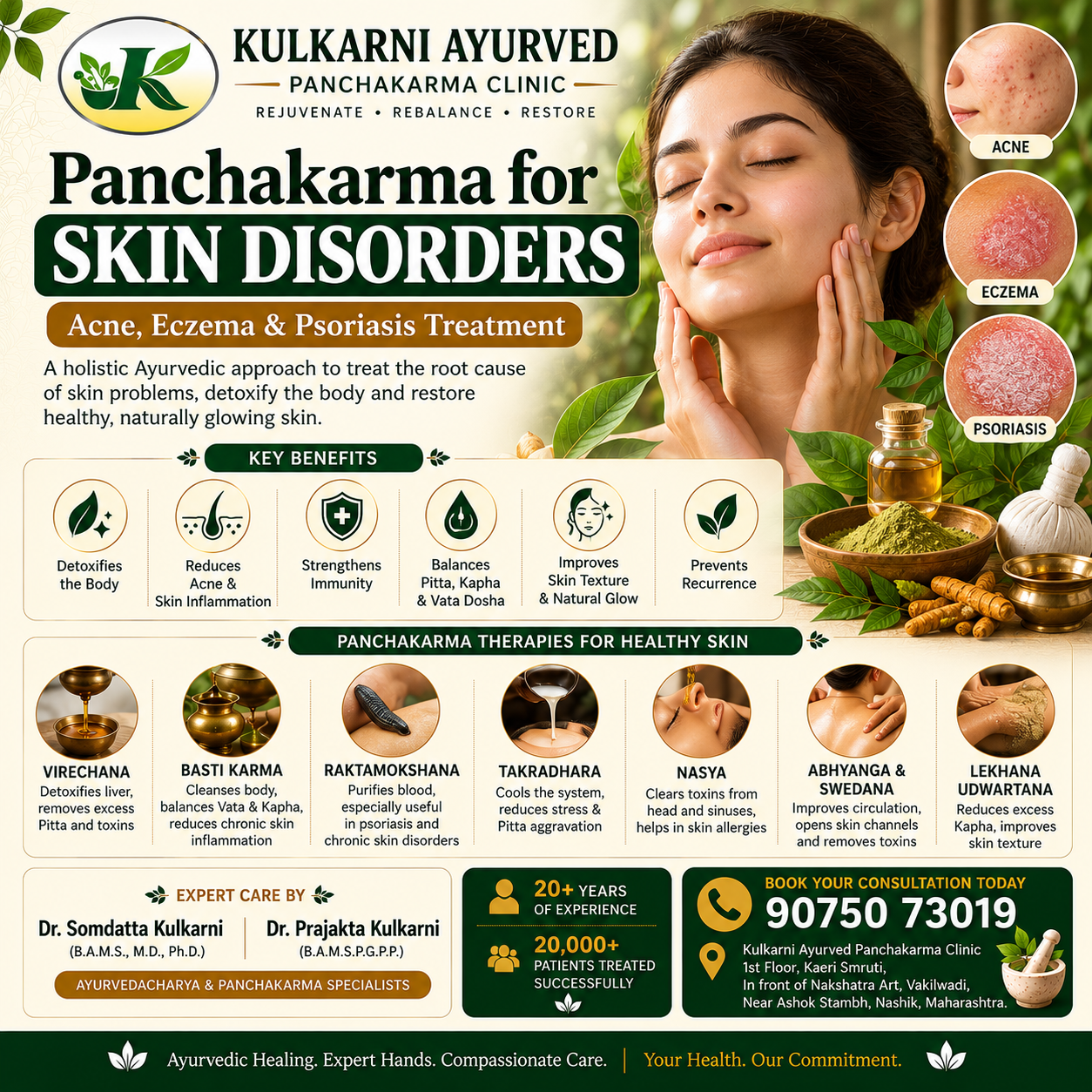
Suffering from chronic acne, eczema, or psoriasis? Dr. Somdatta & Dr. Prajakta Kulkarni explain how Panchakarma treats skin disorders from the root — blood purification, liver detox & Virechana. Best Panchakarma centre in Nashik. The skin never lies. When we see a patient at KULKARNI AYURVED PANCHAKARMA CLINIC, Nashik with chronic acne, persistent eczema, or spreading psoriasis, we do not look at the skin first. We look deeper — at the liver, the gut, the blood, the hormonal system, and the digestive fire that feeds and purifies all of them. Because in Ayurveda — and now increasingly in modern dermatology — the skin is understood as a mirror of internal health, not a separate organ with its own isolated problems. Most chronic skin patients who come to us have spent years treating the surface. Steroid creams, antibiotic courses, anti-fungal washes, retinoids, biologic injections for psoriasis — these treatments suppress what they can see. The redness fades, the lesions shrink, the acne clears — and then, reliably, it all comes back. Because nothing has been done about what is happening in the blood, the liver, and the gut that is driving the skin to express these conditions in the first place. Panchakarma treats skin disorders from the root — not from the surface. In this blog, we explain exactly how — in clear, honest language — so that if you are one of the millions of people in India living with a chronic skin condition that topical treatment has failed to resolve, you understand what is possible through Ayurvedic treatment at KULKARNI AYURVED PANCHAKARMA CLINIC, Nashik. In This Article 1. Why Chronic Skin Disorders Are an Internal Problem 2. How Ayurveda Understands Skin Disorders — Kushtha and Its Root Causes 3. Types of Skin Disorders Treated at Our Nashik Clinic 4. The Skin-Blood-Liver-Gut Connection — Why It Matters 5. Panchakarma Treatments for Skin Disorders — All Options Explained 6. Virechana — The Most Important Skin Treatment in Ayurveda 7. The Complete Panchakarma Skin Treatment Protocol Condition by Condition — Acne, Eczema, Psoriasis, Urticaria 8. Diet and Lifestyle for Healthy Skin — The Ayurvedic Approach 9. What Results Can You Realistically Expect? 10. Why Choose KULKARNI AYURVED PANCHAKARMA CLINIC, Nashik? 11. Frequently Asked Questions 1. Why Chronic Skin Disorders Are an Internal Problem Modern dermatology is increasingly recognising what Ayurveda has understood for millennia — that chronic skin disorders are not skin problems. They are whole-body problems that express themselves on the skin. Consider what research now confirms: - Acne is not caused by dirty skin or bacteria alone. It is driven by insulin resistance (which stimulates sebum overproduction), gut dysbiosis (where certain gut bacteria increase systemic inflammation), hormonal imbalance (particularly androgens in PCOD), and liver congestion (which impairs the clearance of these hormones from the blood) - Eczema is not a skin barrier problem alone. It is an immune dysfunction that begins in the gut — specifically, intestinal permeability (leaky gut) that allows allergens and bacterial toxins into the bloodstream, triggering the systemic immune response that manifests on the skin as inflammation - Psoriasis is an autoimmune condition in which the immune system attacks the skin's keratinocytes — but the trigger for this autoimmune attack is now understood to originate in the gut microbiome, the liver's inflammatory state, and the systemic metabolic condition - Urticaria (chronic hives) is driven by a chronically sensitised immune system — where the threshold for mast cell activation is so low that normal environmental exposures trigger severe responses; the gut-immune axis and liver toxic load are central drivers - Every one of these internal mechanisms — gut dysbiosis, liver congestion, blood toxicity, hormonal imbalance, and immune dysregulation — is something that Panchakarma directly, measurably, and systematically addresses. This is why Panchakarma produces results in chronic skin conditions where years of topical treatment have failed. 2. How Ayurveda Understands Skin Disorders — Kushtha and Its Root Causes All skin disorders in Ayurveda are classified under the broad term Kushtha — a category of 18 conditions described in remarkable clinical detail in the classical texts, ranging from superficial skin discolourations to deep, systemic conditions involving multiple tissue layers. The Ayurvedic texts identify the root causes of Kushtha with an accuracy that modern dermatology research is only now corroborating: 1. Ayurvedic Root Cause is Rakta dushti — toxin-loaded blood, Modern Equivalent is Circulating inflammatory cytokines, blood-borne toxins from gut and liver Skin Conditions Driven By This is Acne, urticaria, eczema, rosacea, boils 2. Ayurvedic Root Cause - Pitta aggravation in Rasa-Rakta Modern Equivalent - Inflammatory state of the blood and lymph; elevated histamine Skin Conditions Driven By This - Rosacea, inflammatory acne, acute eczema, hives 3. Ayurvedic Root Cause - Kapha obstruction of Srotas Modern Equivalent - Sebaceous gland obstruction; clogged lymphatics; keratinocyte hyperproliferation Skin Conditions Driven By This - Cystic acne, sebaceous cysts, thickened psoriatic plaques, Kapha-type eczema 4. Ayurvedic Root Cause - Mandagni and Ama Modern Equivalent - Intestinal permeability, gut dysbiosis, increased intestinal toxin load Skin Conditions Driven By This - Eczema, psoriasis, chronic urticaria, seborrhoeic dermatitis 5. Ayurvedic Root Cause - Yakrit (liver) dysfunction Modern Equivalent - Impaired Phase 1 and Phase 2 liver detoxification; hormonal clearance failure Skin Conditions Driven By This - Hormonal acne, melasma, rosacea, chronic pruritus 6. Ayurvedic Root Cause - Ojas depletion and immune dysregulation Modern Equivalent - Autoimmune skin conditions; hypersensitivity; chronic inflammation Skin Conditions Driven By This - Psoriasis, lichen planus, vitiligo (in part), severe chronic eczema The treatment principle that follows from this understanding is the foundation of our approach at KULKARNI AYURVED PANCHAKARMA CLINIC, Nashik: purify the blood, cleanse the liver, heal the gut, and correct the dosha imbalance that is driving the condition. Do these four things systematically through Panchakarma — and the skin follows. Not as a side effect, but as a direct, measurable, and lasting consequence of the internal restoration. 3. Types of Skin Disorders Treated at Our Nashik Clinic At KULKARNI AYURVED PANCHAKARMA CLINIC, Nashik, we treat the following skin conditions through Panchakarma: Inflammatory skin conditions - Chronic acne and hormonal acne — particularly in women with PCOD, in adults whose acne persists beyond the teen years, and in patients whose acne has failed to respond to antibiotics or retinoids - Rosacea — facial redness, flushing, and inflammatory papules; primarily a Pitta-Rakta condition - Folliculitis — recurrent infected hair follicles; driven by blood-borne Pitta and Ama - Boils and furuncles (Vidradhi) — recurrent skin abscesses indicating deep Pitta-Rakta toxicity Allergic and hypersensitive skin conditions - Eczema / Atopic Dermatitis (Vicharchika) — chronic itching, inflamed, weeping, or dry skin; the most common allergic skin condition - Contact Dermatitis — skin reactions to environmental or chemical contact; driven by hypersensitised immune state - Urticaria / Chronic Hives (Sheetapitta) — spontaneous wheals and flares; one of the conditions that responds most dramatically to Virechana and blood purification - Pruritus (Kandu) — generalised or localised itching without rash; often a sign of blood and liver toxicity Autoimmune and deep skin conditions - Psoriasis (Kitibha / Sidhma) — one of the most complex and most rewarding skin conditions to treat with Panchakarma; requires a dedicated, multi-cycle programme - Lichen Planus — autoimmune inflammatory condition affecting skin and mucous membranes - Vitiligo (Shwitra) — loss of skin pigmentation; requires long-term Ayurvedic management combined with specific phototherapy approaches Pigmentation and texture conditions - Melasma and hyperpigmentation — facial pigmentation driven by hormonal imbalance, liver dysfunction, and sun exposure; responds well to Virechana and hormonal correction - Seborrhoeic Dermatitis — scaly, oily skin on scalp and face; driven by gut dysbiosis and Kapha-Pitta imbalance - Dry, dull skin and premature skin ageing — reflecting depletion of Rasa and Rakta dhatu; responds to nourishing Panchakarma combined with Rasayana 4. The Skin-Blood-Liver-Gut Connection — Why It Matters To understand why Panchakarma works for chronic skin conditions, you need to understand the four-way relationship between the skin, the blood, the liver, and the gut — because Panchakarma treats all four simultaneously: The blood — Rakta dhatu In Ayurveda, the skin is the outermost expression of Rakta dhatu — the blood tissue. A healthy, clear, luminous complexion reflects pure, well-nourished Rakta. A chronically inflamed, toxin-loaded skin reflects Rakta dushti — blood vitiated with Pitta toxins, Ama, and excess heat. This is why blood purification — Raktashodhana — is the central therapeutic goal in all skin disorder treatment in Ayurveda. And Virechana, which eliminates Pitta toxins from the liver-blood axis, is the primary means of achieving it. The liver The liver processes every toxin, hormone, drug, and metabolic waste product that circulates in the blood. When the liver is congested or dysfunctional — through fatty liver, excess medication load, alcohol, high-sugar diet, or chronic metabolic stress — it cannot clear these substances effectively. They re-enter the bloodstream and are then excreted through the skin — the body's largest detoxification organ. This is the mechanism behind hormonal acne (uncleared androgens), urticaria (uncleared histamine and immune complexes), and the generalised skin inflammation of eczema and psoriasis. Treating the liver is treating the skin. The gut Modern dermatology now speaks of the gut-skin axis — the bidirectional relationship between intestinal health and skin condition. Intestinal permeability (leaky gut) allows bacterial toxins (LPS), undigested food antigens, and inflammatory molecules to enter the bloodstream — where they drive systemic inflammation that manifests on the skin as eczema, psoriasis, acne, and urticaria. Gut dysbiosis (imbalanced intestinal bacteria) amplifies this process. Basti karma — Panchakarma's gut-healing therapy — directly addresses this pathway. The skin itself The skin has its own immune function, its own microbiome, and its own metabolic activity. When the internal environment is clean, the skin's own regulatory mechanisms can maintain health. When the internal environment is toxic, the skin is overwhelmed — no topical treatment can compensate for this internal load. Panchakarma removes the internal toxic burden, allowing the skin's own healing mechanisms to function effectively — often producing improvement in chronic skin conditions within weeks that topical treatment has failed to achieve in years. 5. Panchakarma Treatments for Skin Disorders — All Options Explained ⭐ Virechana — Blood Purification and Liver Detox Medicated purgation therapy — the single most important Panchakarma treatment for all skin disorders — is almost always the primary therapy at KULKARNI AYURVED PANCHAKARMA CLINIC, Nashik for chronic skin conditions. Virechana works through the liver-gallbladder-small intestine axis to eliminate accumulated Pitta toxins, inflammatory cytokines, uncleared hormones, and Rakta-gata Ama from the blood and liver simultaneously. The clinical results in skin conditions are consistently among the most dramatic we produce with any Panchakarma therapy — many patients notice visible skin improvement within 2 to 3 weeks of Virechana. Full explanation in Section 6 below. ⭐ Raktamokshana — Therapeutic Bloodletting The most direct blood purification procedure in Ayurveda. In classical texts, Raktamokshana is specifically described as one of the primary treatments for Kushtha (skin disorders), Vatarakta (gout), and Visarpa (spreading inflammatory conditions). At KULKARNI AYURVED PANCHAKARMA CLINIC, Nashik, Raktamokshana for skin conditions is performed through Jalauka (medicinal leech therapy) — the most refined and medically precise form. Medicinal leeches secrete an extraordinary cocktail of therapeutic compounds — hirudin (anticoagulant), hyaluronidase, destabilase, bdellins, and anti-inflammatory enzymes — that purify the local blood, reduce inflammation, and produce a systemic blood-purifying effect. For localised, severe inflammatory skin conditions — psoriatic plaques, chronic eczema patches, boils, and urticarial wheals — Jalauka provides often dramatic and rapid relief where other treatments have failed. ⭐ Vamana — For Kapha-Dominant Skin Conditions Medicated therapeutic emesis — the primary Kapha-eliminating Panchakarma. For skin conditions where Kapha is the dominant factor — thick, oily, sebaceous, or severely itchy and weeping conditions — Vamana removes the excess Kapha from the stomach and upper respiratory-lymphatic system that is feeding the skin condition. Indicated particularly in chronic urticaria with very high Kapha, severe seborrhoeic dermatitis, and some forms of chronic eczema with significant weeping and discharge. ⭐Snehana / Abhyanga — Full-Body Warm Medicated Oil Massage Full-body warm medicated oil massage applied to the entire body before every Panchakarma session. The specific medicated oil is chosen by the doctor based on the skin condition and doshic profile — Pitta-reducing oils with cooling, blood-purifying properties for inflammatory skin conditions; nourishing, Vata-pacifying oils for dry, scaly skin conditions. Abhyanga draws toxins from the peripheral tissues — including the skin itself — into the central digestive system for elimination through the subsequent Panchakarma procedures. ⭐Swedana — Full-Body Medicated Steam Full-body medicated herbal steam for the whole body. Opens the skin channels (Sweda Vaha Srotas), promotes sweat-based elimination of water-soluble toxins, and improves microcirculation in the dermal layer. For Pitta-dominant skin conditions with significant heat and inflammation, Swedana intensity is carefully moderated — excess heat can aggravate Pitta in the skin. For Kapha and Vata-dominant dry skin conditions, full Swedana is highly beneficial. ⭐Lepa — Medicated Herbal Pastes Specific medicated herbal pastes applied externally to the affected skin areas. Unlike commercial cosmetic products, Lepa preparations at KULKARNI AYURVED PANCHAKARMA CLINIC, Nashik are freshly prepared, individually prescribed, and chosen specifically for the type and stage of your skin condition. Lepa works synergistically with the internal Panchakarma procedures — the internal cleansing creates the conditions for topical healing; the Lepa accelerates local resolution of plaques, pigmentation, and inflammatory lesions. ⭐Takradhara — For Inflammatory Scalp and Stress-Driven Skin Medicated buttermilk flow on the forehead. Deeply cooling, anti-inflammatory, and cortisol-reducing. For skin conditions significantly driven or worsened by stress — psoriasis (a well-documented stress-reactive condition), eczema, and urticaria — Takradhara addresses the stress-immune-skin axis that topical treatments never touch. Also used for inflammatory scalp conditions including seborrhoeic dermatitis and scalp psoriasis. ⭐Basti Karma — Gut-Skin Axis Healing Medicated enema therapy — heals the intestinal environment that drives skin inflammation through the gut-skin axis. For patients with eczema, psoriasis, or chronic urticaria where gut dysbiosis and intestinal permeability are key drivers, Basti karma is an essential component of the skin Panchakarma protocol. Reduces the systemic inflammatory load that the gut is feeding to the skin, corrects the autoimmune trigger at the intestinal level in psoriasis, and improves overall immune regulation. 6. Virechana — The Most Important Skin Treatment in Ayurveda Virechana holds a special place in skin disorder treatment in Ayurveda. The classical texts are unambiguous: 'Kushtha Rogaanaam Virechanam Pradhaanam Chikitsitam — For skin disorders, Virechana is the primary treatment.' — Charaka Samhita, Chikitsa Sthana The reason is anatomical and physiological: the skin and the liver are metabolically the closest organ pair in the body. The liver processes toxins; the skin excretes what the liver cannot process. When Virechana deeply cleanses the liver, the skin's toxic load drops dramatically — and the inflammatory, allergic, or autoimmune process driving the skin condition loses its primary fuel source. What Virechana achieves specifically for skin conditions - Eliminates Pitta toxins from the blood and lymph — the primary inflammatory drivers of acne, rosacea, urticaria, and inflammatory eczema are cleared at the source - Restores liver hormone clearance — uncleared androgens driving hormonal acne; uncleared oestrogens causing melasma; elevated inflammatory mediators causing psoriasis — all are addressed through hepatic detoxification - Reduces the inflammatory burden on the skin — the skin stops having to excrete what the liver is not processing; its own immune and barrier function can restore - Improves gut bile flow — better bile production and flow supports fat-soluble toxin elimination and reduces intestinal permeability, cutting off one of the primary feeds to eczema and psoriasis - Measurable outcomes — SGPT, SGOT, inflammatory markers, and hormonal reports all improve alongside the visible skin improvement; the skin result and the blood report result are two expressions of the same internal restoration 7. The Complete Panchakarma Skin Treatment Protocol Step 1: Detailed Consultation and Skin Assessment Your doctor reviews your complete skin history — duration, progression, triggers, previous treatments and their outcomes, current medicines, associated conditions (PCOD, thyroid, diabetes, gut issues), diet, stress levels, and any relevant blood or biopsy reports. Nadi Pariksha (pulse diagnosis) identifies the specific doshic root of your skin condition. A completely personalised programme is designed — including specific therapies, the number of cycles needed, and the specific medicated preparations for your condition. ⚠️ Important: Always consult a qualified Ayurvedacharya before starting Panchakarma. At KULKARNI AYURVED PANCHAKARMA CLINIC, Nashik, every patient undergoes a thorough medical assessment — including Nadi Pariksha (pulse diagnosis) — before any treatment begins. Your safety is our first priority. Step 2: Purvakarma — Preparation Phase (Days 1 to 5 to 7) Full-body Snehana (warm medicated oil massage to the entire body) and full-body Swedana (medicated herbal steam for the whole body) daily. Internal Snehana (specific medicated ghee preparations) is given to mobilise deep-seated toxins from the blood, lymph, and liver into the digestive system for elimination. For Pitta-dominant inflammatory skin conditions, specific Pitta-reducing ghee preparations are used; for Kapha-dominant skin conditions, lighter, drier preparations are chosen. This phase is critical for the depth of skin clearance that Virechana subsequently achieves. Step 3: Pradhanakarma — Main Treatment Phase (Days 7 to 21) Virechana — the primary treatment; performed after confirmed adequate preparation; the most important single intervention for all skin conditions Raktamokshana (Jalauka) — for localised severe skin conditions, active psoriatic plaques, chronic eczema patches, and urticaria; performed after Virechana on specifically indicated areas Vamana — for high Kapha skin conditions where indicated Basti karma — Yoga Basti or Kala Basti to heal the gut-skin axis and correct autoimmune dysregulation Takradhara — for stress-reactive skin conditions and inflammatory scalp Lepa — daily external medicated herbal paste application to affected areas, individually prepared Herbal medicines — prescribed after thorough examination of the patient; continued until the desired skin clearance and internal marker improvement are achieved Step 4: Paschatkarma — Post-Treatment Plan Herbal medicines continued until skin is clear and blood reports confirm internal normalisation. A detailed skin-specific Ayurvedic diet plan. Sun exposure and skincare guidance. Stress management protocols. Specific seasonal Panchakarma recommendations — as many skin conditions are cyclically worse in summer (Pitta-aggravating) and require annual Virechana in late summer / early autumn. Follow-up at 30 days, 90 days, and 6 months with repeat blood reports and photographic skin assessment. 8. Condition by Condition — Acne, Eczema, Psoriasis, Urticaria Chronic Acne and Hormonal Acne Acne in adults — particularly women with PCOD, hormonal fluctuations, or those whose acne persists or worsens in their 20s and 30s — is one of the most emotionally distressing and one of the most treatable conditions through Panchakarma at KULKARNI AYURVED PANCHAKARMA CLINIC, Nashik. The Ayurvedic root: excess Pitta and Kapha in the Rakta and Meda dhatu, combined with liver dysfunction impairing androgen clearance. The treatment: Virechana to cleanse the liver and blood; Lekhana Basti to correct insulin resistance (which drives sebum overproduction); Lepa for active lesions; internal medicines to regulate the hormonal axis. For women with both PCOD and acne, the PCOD Panchakarma protocol (including Uttara Basti) addresses both conditions simultaneously. Most acne patients see their clearest skin in years within 4 to 6 weeks of completing Virechana. Eczema — Atopic Dermatitis (Vicharchika) Eczema is classified in Ayurveda as Vicharchika — characterised by itching, discolouration, oozing, and rough skin texture. It is primarily a Pitta-Kapha-Rakta condition, with significant gut-immune axis involvement. The treatment approach depends on the current phase: - In an acute, weeping, inflammatory phase: Virechana after careful preparation reduces the acute Pitta-Rakta toxicity; Lepa with cooling, drying preparations; Basti to reduce intestinal permeability; internal medicines to reduce immune hypersensitivity - In a chronic, dry, thickened phase: Nourishing Abhyanga with specific oils, Basti karma for gut healing, Lepa with moisturising preparations, and internal Rasayana medicines to rebuild the depleted Rakta and Rasa dhatu - Eczema typically requires multiple cycles of Panchakarma — 2 to 3 seasonal programmes over 1 to 2 years for significant, sustained clearance. Steroid creams can be gradually reduced under the supervision of the dermatologist as Panchakarma takes effect — never stopped abruptly. Most eczema patients at KULKARNI AYURVED PANCHAKARMA CLINIC, Nashik achieve significant reduction in itch and inflammation within the first programme, with progressively longer remission periods after each subsequent cycle. Psoriasis (Kitibha / Sidhma) Psoriasis is one of the most challenging — and most professionally rewarding — skin conditions we treat at KULKARNI AYURVED PANCHAKARMA CLINIC, Nashik. It is classified in Ayurveda under Mahakushtha — the major skin disorders — reflecting the systemic, deep-seated, and multi-doshic nature of the condition. The Ayurvedic understanding of psoriasis involves all three doshas — Kapha forming the scale and thickened plaque; Pitta driving the inflammation, redness, and burning beneath; Vata causing the dryness, cracking, and rapid keratinocyte turnover. Ama and Rakta dushti are always significantly involved. Treatment therefore uses a sequence of procedures: 1. Virechana — primary cleansing of the Pitta-Rakta axis; typically 2 to 3 cycles over 12 months 2. Raktamokshana (Jalauka) — direct blood purification and plaque reduction at specific sites Basti karma — gut-immune axis healing; reduces the autoimmune trigger 3. Takradhara — stress-psoriasis axis correction; scalp psoriasis management 4. Lepa — specific external preparations for plaque resolution; individually prepared 5. Long-term internal medicines — prescribed after thorough examination, continued for 12 to 24 months as the immune reprogramming process requires sustained herbal support 6. Realistic expectation for psoriasis: significant reduction in plaque area and thickness within the first programme; progressive clearance over 2 to 3 cycles. Complete clearance is achievable in moderate to severe cases with full compliance. Psoriasis can recur — particularly with stress, alcohol, or significant dietary violation. Annual maintenance Panchakarma prevents and manages recurrence. Urticaria — Chronic Hives (Sheetapitta) Chronic urticaria is one of the conditions where a single well-conducted Virechana produces some of the most dramatic results we see in dermatology practice at KULKARNI AYURVED PANCHAKARMA CLINIC, Nashik. Urticaria is driven by a chronically sensitised immune state — and Virechana, by removing the blood-borne Pitta toxins and Ama that are keeping the immune system in this state of hyperactivation, effectively resets the immune threshold. Many patients who have been on daily antihistamines for months or years achieve complete, sustained remission within 4 to 6 weeks of a Virechana programme. For cold urticaria (Sheetapitta with cold as the trigger), specific warming, Vata-reducing Basti preparations are added to the protocol. 9. Diet and Lifestyle for Healthy Skin — The Ayurvedic Approach What you eat every day feeds or inflames your skin. Panchakarma provides the deep internal reset — but diet is what determines whether the skin stays clear after that reset. Foods that heal the skin — eat more of these - Amla (Indian gooseberry) — the most powerful Ayurvedic skin food; the richest natural source of Vitamin C; deeply blood-purifying, liver-protective, and skin-nourishing; consumed daily in any form - Bitter vegetables daily — karela, methi, neem leaves, drumstick (moringa); bitter taste is directly blood-purifying in Ayurveda and reduces Pitta-Rakta toxicity - Turmeric with warm milk or warm water — anti-inflammatory, blood-purifying, and liver-supportive; the most important single spice for skin health - Coriander and cumin — cooling digestive spices that reduce Pitta without suppressing Agni; add generously to all cooking - Moong dal and green leafy vegetables — the lightest, cleanest protein and iron sources that nourish blood without loading the liver - Coconut water — cooling, blood-purifying, and deeply hydrating at the cellular level; excellent for all Pitta-dominant skin conditions - Pomegranate — one of the finest blood-purifying fruits in Ayurveda; reduces oxidative stress in the Rakta dhatu - Warm water consistently — the simplest and most overlooked skin treatment; flushes toxins from the lymphatic and vascular systems continuously Foods that inflame the skin — strictly reduce or avoid - Refined sugar in all forms — insulin spikes from sugar directly increase sebum production, worsen acne, and increase systemic inflammation that flares eczema and psoriasis - Maida and processed food — increases intestinal permeability and gut-skin axis toxin load; one of the most reliable eczema and psoriasis triggers - Sour, fermented, and pickled foods — strongly Pitta-aggravating; curd, vinegar, tamarind, alcohol, and fermented foods worsen all inflammatory skin conditions - Spicy food in excess — increases Pitta in the blood and skin; strongly contraindicated in acne, rosacea, urticaria, and psoriasis - Alcohol — directly toxic to the liver and severely pro-inflammatory; one of the most powerful psoriasis triggers - Curd at night — generates Ama overnight; one of the most commonly overlooked causes of persistent skin inflammation in Indian patients - Excess non-vegetarian food — particularly red meat; high in arachidonic acid that is metabolised into pro-inflammatory prostaglandins - Incompatible food combinations (Viruddha Ahara) — milk with sour fruits, fish with milk, or heated honey — these combinations generate specific Ama types that particularly affect the skin channels Lifestyle essentials for skin health - Sleep before 10:30 PM — peak liver detoxification occurs between 10 PM and 2 AM; staying awake during this window is one of the most common causes of persistent acne and skin dullness - Stress management — cortisol directly triggers sebum overproduction, increases skin inflammation, and destabilises the immune threshold in eczema and psoriasis; daily Pranayama for 15 minutes is non-negotiable - Warm water face wash — never hot or cold — extreme temperatures damage the skin barrier; lukewarm water with minimal soap preserves the skin's natural microbiome - Avoid vigorous scrubbing of skin lesions — in eczema and psoriasis, aggressive scrubbing worsens the Vata-dryness component and triggers Koebner phenomenon in psoriasis - Cotton clothing — synthetic fabrics trap heat and sweat, aggravating Pitta-skin conditions; breathable cotton is always preferred - Moderate sun exposure — 15 to 20 minutes of morning sun (before 9 AM) is beneficial for Vitamin D synthesis and psoriasis management; intense midday sun is strictly avoided in Pitta-dominant skin conditions 11. Why Choose KULKARNI AYURVED PANCHAKARMA CLINIC, Nashik? If you are searching for Ayurvedic skin treatment in Nashik, Panchakarma for acne in Nashik, psoriasis Ayurvedic treatment in Nashik, eczema natural treatment in Nashik, or the best Panchakarma centre in Nashik for skin disorders — here is why KULKARNI AYURVED PANCHAKARMA CLINIC is the right choice: - 20+ years and 20, 000+ patients — skin disorders are one of the most common conditions we treat; we have extensive clinical experience with every type of skin disorder at every stage of severity - Root-cause treatment — not surface management — we treat the blood, the liver, the gut, and the hormonal system that is driving your skin condition, not just the skin surface; this is why our results last - Classical Virechana with internal Snehana preparation — the depth of our Virechana preparation is what produces the deep blood purification that skin conditions require; we never skip the internal oleation phase that most clinics abbreviate - Raktamokshana available — Jalauka (leech therapy) for skin conditions is performed at our clinic by experienced doctors; this procedure is only available at clinics with appropriate training and certification - Integrated hormonal and skin treatment — for women with PCOD and acne, for patients with thyroid and skin changes, for patients with diabetes and skin complications — we treat the complete metabolic picture, not just the visible skin - Two qualified specialists — Dr. Somdatta Kulkarni (B.A.M.S., M.D., Ph.D) and Dr. Prajakta Kulkarni (B.A.M.S.P.G.P.P.) personally assess and supervise every treatment programme - Safe coordination with dermatologist — we work alongside your dermatologist; steroid reduction is done only with the dermatologist's guidance as Panchakarma takes effect; we never advise abrupt medicine discontinuation - Conveniently located — 1st Floor, Kaveri Smruti, Near Nakshatra Art, Vakilwadi, Near Ashok Stambh, Nashik, Maharashtra 12. Frequently Asked Questions Can Panchakarma permanently cure psoriasis? Psoriasis is a chronic autoimmune condition — and complete permanent cure, in the sense of never having a recurrence under any circumstances, is not a realistic promise for any treatment, allopathic or Ayurvedic. What Panchakarma consistently achieves at KULKARNI AYURVED PANCHAKARMA CLINIC, Nashik is this: significant clearance of plaques, sustained periods of complete remission (often 6 to 18 months after each programme), and reduction of recurrence frequency and severity with annual maintenance Panchakarma. For many patients, this constitutes a quality of life transformation. Many patients who came to us on biologics or methotrexate have been able to reduce or discontinue these medicines under their dermatologist's supervision as Panchakarma achieved sustained clearance. 'Manageable long-term with annual Panchakarma' is an honest and achievable goal — and far better than lifetime immunosuppression. My child has eczema. Is Panchakarma safe for children? Yes — Panchakarma can be safely adapted for children above 5 to 7 years of age with appropriate modifications in therapy selection, intensity, and dosing. Virechana is modified for children — milder preparations and careful dose calibration. Abhyanga, Lepa, and specific internal medicines are very well tolerated and often produce remarkable results in childhood eczema. We treat paediatric skin conditions frequently at KULKARNI AYURVED PANCHAKARMA CLINIC, Nashik. Please bring your child's full history and current medicines to the consultation so our doctors can design the safest and most effective programme for their age and condition. I am currently on biologic injections for psoriasis. Can I have Panchakarma alongside? This requires careful individual assessment. Biologics are powerful immunosuppressants — and some Panchakarma procedures, particularly Virechana, involve a temporary immune stimulation as part of their cleansing mechanism. Our doctors will review your current biologic, your psoriasis severity, and your overall health before advising on how to safely integrate Panchakarma. In general, Panchakarma can be introduced alongside biologics; the biologic is maintained while Panchakarma works progressively; dose reduction of the biologic is discussed with your dermatologist as improvement is demonstrated. We never advise stopping biologics abruptly. Why does my acne always come back after antibiotic courses? Will Panchakarma be different? Antibiotics work by reducing the bacterial component of acne — Cutibacterium acnes. But they do nothing about the sebum overproduction driven by insulin resistance, the hormonal androgen excess driving the sebaceous glands, or the liver's impaired androgen clearance. These root causes continue operating, and when the antibiotic is stopped, the skin conditions that these root causes produce return. Panchakarma — specifically Virechana for liver and blood cleansing, Lekhana Basti for insulin resistance correction, and hormonal treatment (particularly Uttara Basti in women with PCOD) — addresses these root causes. This is why results from Panchakarma are more durable than antibiotic courses for adult hormonal acne. Can Virechana make my skin condition temporarily worse before it gets better? In some patients — particularly those with significant blood-borne toxin load — there is a brief initial skin reaction in the 2 to 5 days after Virechana, as mobilised toxins clear through the skin channels. Existing acne may temporarily flare; eczema may temporarily increase in intensity. This is a normal, expected, and therapeutically positive sign — it confirms that the cleansing is working at a deep level. Our doctors at KULKARNI AYURVED PANCHAKARMA CLINIC, Nashik prepare every patient for this possibility beforehand and provide appropriate external and internal support to manage it. The clearing phase typically passes within 5 to 7 days and is followed by often dramatic improvement. Is the diet for skin conditions very restrictive? Can I follow it in my daily life? The Ayurvedic diet for skin conditions is not about eating bland or tasteless food — it is about understanding which qualities aggravate your specific skin condition and making intelligent, satisfying alternatives. Spicy food can be replaced with cooling, flavourful alternatives using coriander, cumin, and fennel. Sugar can be replaced with the natural sweetness of fruits, dates, and jaggery in small quantities. Sour curd can be replaced with warm buttermilk. Most patients find the diet very manageable once they understand the logic behind it — and crucially, most patients find their cravings for the problematic foods reduce significantly after Virechana, because the Pitta imbalance driving those cravings has been corrected. I have both PCOD and acne. Do I need separate treatments for each? No — this is one of the most efficient treatment situations we encounter at KULKARNI AYURVED PANCHAKARMA CLINIC, Nashik. PCOD and hormonal acne share the same Ayurvedic root cause — liver dysfunction impairing androgen clearance, combined with insulin resistance driving sebum overproduction. The PCOD Panchakarma programme — Virechana, Uttara Basti, Lekhana Basti, and internal medicines — treats both simultaneously. Most women with both PCOD and acne see improvement in both their menstrual regularity and their skin clarity from the same programme. Dr. Prajakta Kulkarni, who specialises in gynaecological disorders and Uttara Basti, manages the gynaecological component; the combined approach is one of our most consistently successful treatment outcomes. What is the cost of Panchakarma skin treatment at KULKARNI AYURVED PANCHAKARMA CLINIC, Nashik? The cost depends on the specific skin condition, the therapies required, the number of sessions, and whether Raktamokshana is included. Please call us at 90750 73019 or visit our clinic at 1st Floor, Kaeri Smruti, Vakilwadi, Near Ashok Stambh, Nashik for a detailed consultation and a transparent cost estimate. We explain all costs clearly before any treatment begins — no hidden charges and no obligation. Clear Skin Starts from Within — Not from a Cream Your skin is not the problem — it is the messenger. The problem is in the blood, the liver, the gut, and the hormonal system beneath. Panchakarma at KULKARNI AYURVED PANCHAKARMA CLINIC, Nashik treats the message at its source — so that the skin can finally, truly heal. Not for a few weeks until the steroid cream runs out. But lastingly, from the root. 📞 Call 90750 73019 | 💬 WhatsApp: 90750 73019 Free initial consultation · Personalised Panchakarma programme · 20+ Years Experience · KULKARNI AYURVED PANCHAKARMA CLINIC, Nashik