


2026-07-10T07:02:47
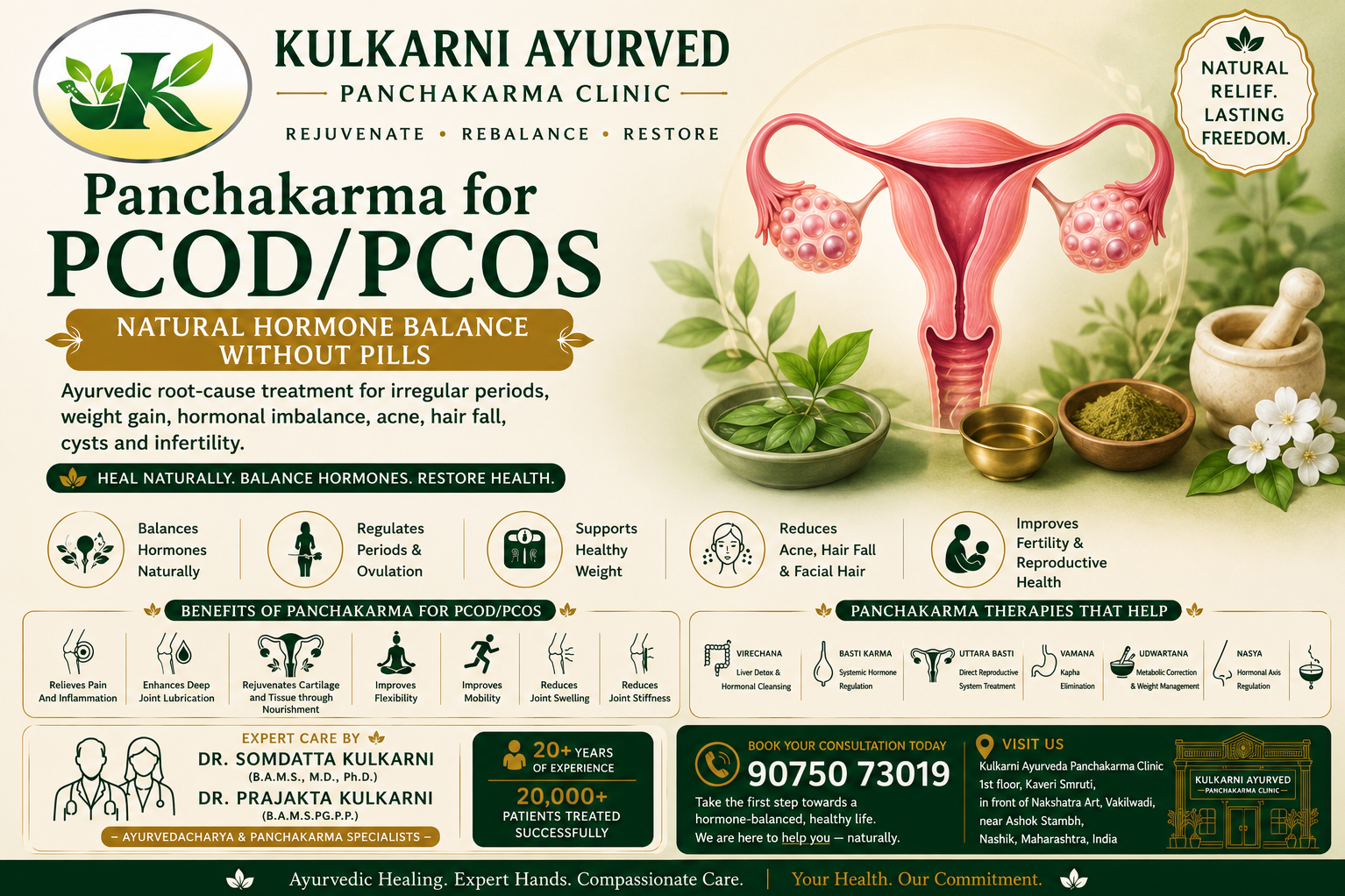
Struggling with PCOD or PCOS? Dr. Somdatta & Dr. Prajakta Kulkarni explain how Panchakarma treats PCOD naturally — irregular periods, weight gain, hormonal imbalance & infertility. Best Panchakarma centre in Nashik. Every week at KULKARNI AYURVED PANCHAKARMA CLINIC, Nashik, we meet women who have been living with PCOD for years — some since their teenage years. They come to us carrying a weight that goes far beyond their physical symptoms. They have been told their periods will never be regular without the pill. They have been told their hormones are permanently imbalanced. They have been told that losing weight with PCOD is nearly impossible. And many have been trying to conceive for months or years without success. We tell them the same thing every time: Ayurveda has understood this condition for thousands of years. It has a name — Aartava Kshaya — and it has a complete, systematic treatment. And in over 20 years of practice, we have seen hundreds of women with PCOD achieve regular cycles, balanced hormones, healthy weight, and successful pregnancies — through Panchakarma, without depending on synthetic hormones for life. In this article 1. What is PCOD / PCOS — and is there a difference? 2. How Ayurveda understands PCOD — the root cause 3. Why hormonal pills are not the only answer 4. Panchakarma treatments for PCOD — all options explained 5. Uttara Basti — the most specialised treatment for female reproductive health 6. The complete Ayurvedic PCOD treatment protocol 7. PCOD and infertility — how Panchakarma helps 8. Diet and lifestyle for PCOD — the Ayurvedic approach 9. What results can you realistically expect? 10.Why choose KULKARNI AYURVED PANCHAKARMA CLINIC, Nashik? 11. Frequently asked questions 1. What is PCOD / PCOS — and is there a difference? PCOD (Polycystic Ovarian Disease) refers to a condition in which the ovaries release immature or partially mature eggs that accumulate over time and form cysts. This is largely a lifestyle-driven condition. With the right treatment and lifestyle changes, it is highly reversible. PCOS (Polycystic Ovarian Syndrome) is a more complex metabolic-endocrine disorder in which the ovaries produce excess androgens (male hormones). It is associated with insulin resistance, significant metabolic changes, and is considered a syndrome rather than just an ovarian condition. Both conditions share common features — irregular or absent periods, excess male hormone symptoms (acne, unwanted facial hair, hair loss), cysts on the ovaries seen on ultrasound, difficulty conceiving, and weight gain. Together, they affect approximately 1 in 5 women in India today. Whether your diagnosis is PCOD or PCOS, Ayurvedic treatment at KULKARNI AYURVEDPANCHAKARMA CLINIC, Nashik addresses the root cause of both — the hormonal imbalance, the metabolic dysfunction, and the ovarian condition — not just the symptoms. 2. How Ayurveda understands PCOD — the root cause In Ayurveda, PCOD is understood as a disorder primarily involving the imbalance of Kapha and Vata doshas, with secondary involvement of Pitta in the liver and metabolic pathways. It is linked to weakened Agni (digestive fire) and accumulation of Ama (metabolic toxins) in the Aartava Vaha Srotas — the channels governing female reproductive physiology. Here is what happens in PCOD from an Ayurvedic perspective: 1. Agni weakens — due to poor diet, irregular eating, stress, and sedentary lifestyle 2. Ama accumulates — unprocessed metabolic waste clogs the reproductive channels, blocking normal egg maturation and release 3. Kapha accumulates in the ovaries — creating the physical cysts that appear on ultrasound 4. Vata is disturbed — causing irregular or absent periods (Aartava Kshaya) and hormonal fluctuations 5. Pitta is aggravated — in the liver, causing impaired hormone metabolism, elevated androgens, and insulin resistance This Ayurvedic understanding directly maps onto modern medicine's findings — that PCOD involves insulin resistance, impaired liver function, inflammatory processes, and hormonal dysregulation. Ayurveda understood these interconnections thousands of years before modern endocrinology named them. 3. Why hormonal pills are not the only answer We are not against allopathic medicine. Hormonal therapies have their role in managing PCOD symptoms in the short term. However, every woman with PCOD should understand what hormonal pills do and do not do: What hormonal pills DO - - Regulate periods by introducing external hormones - Reduce androgen symptoms temporarily - Provide contraception - Manage symptoms while you are taking them - Act quickly — within 1 to 3 cycles What hormonal pills do NOT do - - Fix the root hormonal imbalance that caused irregular periods - Correct the ovarian function or dissolve the cysts - Improve fertility — fertility may further decline if pills are taken long-term - Continue working once you stop — symptoms typically return within months - Address insulin resistance, liver function, or metabolic correction Most women with PCOD who come to KULKARNI AYURVED PANCHAKARMA CLINIC, Nashik have been on hormonal pills for 2, 5, or even 10 years — and when they stop, all their symptoms return. Panchakarma aims to correct the underlying condition so the body can function normally on its own. 4. Panchakarma treatments for PCOD — all options explained ⭐ Virechana — liver detox and hormonal cleansing Medicated purgation therapy — the primary and most important treatment for PCOD. The liver is the primary organ of hormone metabolism. When congested with Ama and Pitta toxins, it fails to clear hormones efficiently. Virechana deeply cleanses the liver, gallbladder, and small intestine, restoring normal hormone metabolism at the source. After a properly conducted Virechana, patients typically notice improvement in menstrual regularity, reduction in acne and facial hair, and improvement in blood reports (FSH, LH ratio, testosterone, insulin) within 6 to 8 weeks. ⭐ Uttara Basti — direct reproductive system treatment A specialised medicated preparation administered through the vaginal route directly into the uterine cavity. This is the most targeted treatment for PCOD — including PCOD, infertility, uterine conditions, recurrent miscarriage, endometrial polyp, thin uterine lining, and tubal block. (Full details in Section 5.) ⭐ Basti karma — systemic hormone regulation Medicated enema therapy — the most powerful Panchakarma treatment for Vata regulation. Vata governs all hormonal timing and signalling — the pulsatile release of GnRH, FSH, and LH. When Vata is disturbed, these hormonal pulses become erratic, causing the irregular cycles and anovulation of PCOD. Basti corrects this fundamental hormonal timing from the root. ⭐ Udwartana — metabolic correction and weight managementDeep herbal powder massage that breaks down Kapha-related fat deposits, improves insulin sensitivity, and stimulates lymphatic drainage. For PCOD patients who also struggle with weight gain and insulin resistance, Udwartana addresses the metabolic dimension that hormonal pills never touch. ⭐ Nasya — hormonal axis regulation Medicated nasal drops that work on the hypothalamic-pituitary axis — the master control centre of the hormonal system. Nasya influences these glands directly, helping to normalise FSH, LH, and prolactin levels that are disturbed in PCOD. ⭐ Shirodhara — stress axis correction Continuous warm medicated oil flow on the forehead. Chronic stress elevates cortisol, which worsens insulin resistance and directly disrupts ovarian hormone production. Shirodhara powerfully reduces cortisol and calms the sympathetic nervous system. Many patients notice improvement in sleep, anxiety, and menstrual regularity even after the first few sessions. 5. Uttara Basti — the most specialised treatment for female reproductive health Uttara Basti is performed with particular expertise at KULKARNI AYURVED PANCHAKARMA CLINIC, Nashik under the supervision of Dr. Prajakta Kulkarni, who specialises in gynaecological disorders and infertility. What Uttara Basti treats - - PCOD and ovarian cysts — directly reduces cystic accumulation in the ovarian environment - Infertility due to anovulation — stimulates and regulates ovulation naturally - Uterine conditions — normalises the uterine environment for implantation - Recurrent miscarriage — strengthens the uterine lining and reduces implantation failure - Endometrial polyp — medicated preparations help reduce polyp formation - Thin uterine lining — nourishes and thickens the endometrium for successful implantation - Tubal block — medicated oils and decoctions help clear obstruction in the fallopian tubes - Irregular or absent periods — directly stimulates and regulates the menstrual cycle - Dysmenorrhoea — reduces painful periods by addressing the underlying uterine dysfunction How is Uttara Basti given? Uttara Basti is administered on specific days of the menstrual cycle — typically in the follicular phase (after the period ends, before ovulation). It takes approximately 15 to 20 minutes per session. Most patients experience only mild discomfort — less than a cervical smear test. A typical course involves 3 to 9 sessions over 1 to 3 consecutive menstrual cycles. ⚠️ Important: Uttara Basti must be performed only by a qualified, trained Ayurvedic gynaecological specialist. Always consult a qualified Ayurvedacharya before starting. At KULKARNI AYURVED PANCHAKARMA CLINIC, Nashik, every patient undergoes a thorough medical assessment — including Nadi Pariksha (pulse diagnosis) — before any treatment begins. Your safety is our first priority. 6. The complete Ayurvedic PCOD treatment protocol Step 1: Detailed consultation and hormonal assessment - Your doctor reviews your complete menstrual history, symptoms, ultrasound reports, hormonal blood reports (FSH, LH, testosterone, DHEAS, thyroid, insulin, AMH), and current medicines. Nadi Pariksha is performed. A completely personalised treatment plan is designed — including the specific therapies, their sequence, the timing relative to your menstrual cycle, and the duration. Step 2: Purvakarma — preparation phase (Days 1 to 5) Full-body Snehana (warm medicated oil massage to the entire body) and full-body Swedana (medicated herbal steam for the whole body) are performed daily. This prepares the body for the deeper Panchakarma procedures. Step 3: Pradhanakarma — main Panchakarma phase (Days 5 to 21) - Virechana — the most important cleansing therapy for PCOD, performed after adequate preparation - Basti karma — a course of Yoga Basti or Kala Basti to correct the hormonal Vata axis - Udwartana — for metabolic correction and weight management where applicable - Shirodhara — for stress axis and pituitary regulation - Nasya — for hypothalamic-pituitary axis normalisation - Herbal medicines — prescribed after thorough examination of the patient; continued until the desired results are achieved Step 4: Uttara Basti course — cycle-synchronised (1 to 3 months) After the main Panchakarma programme, Uttara Basti is administered in sessions timed to the patient's menstrual cycle. Most patients begin to see improvement in menstrual cycle regularity and ultrasound findings during this phase. Step 5: Paschatkarma — post-treatment plan Herbal medicines continued until desired results are achieved, a detailed Ayurvedic diet plan, yoga and exercise recommendations, and a specific daily routine (Dinacharya) are prescribed. Follow-up consultations at 30 days, 90 days, and 6 months monitor progress. 7. PCOD and infertility — how Panchakarma helps At KULKARNI AYURVED PANCHAKARMA CLINIC, Nashik, we have helped many women with PCOD-related infertility achieve natural conception — some after years of failed attempts and failed IVF cycles. Here is how Panchakarma addresses PCOD-related infertility specifically: Restoring natural ovulation The most common cause of PCOD-related infertility is anovulation. Virechana, Basti karma, and Uttara Basti work together to dissolve the cystic Kapha blocking egg maturation, correct the hormonal signals that trigger ovulation, and restore the natural LH surge. When ovulation is restored naturally, conception becomes possible without fertility drugs. Improving egg quality In Ayurveda, the quality of the female egg (Beeja) is directly related to the health of the Aartava dhatu (reproductive tissue). Virechana, nourishing Basti, and Uttara Basti cleanse the reproductive tissue of Ama and nourish it deeply. Women who conceive after Panchakarma consistently report better embryo quality in IVF settings as well. Preparing the uterus for implantation Uttara Basti directly addresses thin uterine lining, endometrial polyps, and uterine inflammation — nourishing and thickening the endometrium and creating the optimal uterine environment for implantation and early pregnancy. Supporting male fertility alongside female treatment Panchakarma — particularly Basti therapy — is highly effective for improving sperm count, motility, and morphology through nourishment of the Shukra dhatu (male reproductive tissue). We recommend that both partners undergo Ayurvedic assessment simultaneously for the best outcomes. 8. Diet and lifestyle for PCOD — the Ayurvedic approach Eat more of these - Warm, freshly cooked meals — always over cold, stale, or processed food - Bitter and astringent vegetables — karela, methi, palak, drumstick, turmeric, ridge gourd - Ragi, Jowar, Bajra — low glycaemic index grains that do not spike insulin - Moong dal — the lightest, most easily digested protein - Flaxseeds and sesame seeds — support oestrogen metabolism and hormonal balance - Warm water throughout the day — never cold water, which suppresses Agni - Amla (Indian gooseberry) — the richest natural source of -Vitamin C and a powerful liver tonic - Reduce or avoid these - Refined sugar in all forms — directly worsens insulin resistance, the central metabolic problem of PCOS - Maida (refined flour) — bread, biscuits, noodles, pizza, pasta — all rapidly spike insulin - Cold beverages and cold food — suppress Agni directly - Excess dairy — especially curd, cheese, and cold milk — increases Kapha and can worsen cyst formation - Day sleeping — strongly contraindicated in PCOD; increases Kapha and slows metabolism - Skipping meals — causes Vata aggravation and worsens hormonal irregularity Lifestyle essentials for PCOD - Regular exercise — 30 to 45 minutes of moderate activity daily; walking, yoga, and swimming are ideal - Yoga asanas for PCOD — Baddha Konasana, Supta Baddha Konasana, Setu Bandhasana, Viparita Karani, Nadi Shodhana Pranayama - Fixed meal times — biggest meal at lunch, light dinner before 7:30 PM, nothing after 8 PM - Consistent sleep — sleep before 10:30 PM, wake before 6:30 AM. Irregular sleep directly disturbs hormonal rhythms. - Stress management — daily Pranayama or meditation significantly reduces cortisol, a major driver of PCOD 9. What results can you realistically expect? During treatment (Days 1–21) - Improvement in energy, digestion, and skin clarity. Reduced bloating and water retention. Better sleep. Reduction in acne within 2 to 3 weeks. First period after treatment Many patients notice more regular timing, reduced pain, and better flow. Some take 2 to 3 cycles to fully regularise. 4 to 8 weeks after treatment- Improvement in hormonal blood reports — FSH/LH ratio normalises, testosterone reduces, insulin sensitivity improves. Less facial hair, less acne. 3 to 6 months - Regular menstrual cycles in a large majority of patients. Significant reduction or disappearance of cysts on ultrasound in many cases. Sustainable weight loss. 6 to 12 months (fertility patients) - Natural conception in many patients with PCOD-related infertility who complete the full programme. Better IVF response for those pursuing assisted conception. 10. Why choose KULKARNI AYURVED PANCHAKARMA CLINIC, Nashik? - Specialist expertise in female reproductive health — Dr. Prajakta Kulkarni's specialisation in gynaecological disorders, Garbhasanskar, infertility, and Uttara Basti makes her one of the most experienced Ayurvedic gynaecology specialists in Nashik - 20+ years and 20, 000+ patients — including hundreds of PCOD cases successfully treated - Both doctors qualified and experienced — Dr. Somdatta Kulkarni (B.A.M.S., M.D., Ph.D) manages the metabolic and Panchakarma aspects; Dr. Prajakta Kulkarni (B.A.M.S.P.G.P.P.) specialises in the gynaecological and reproductive dimensions - Uttara Basti performed by a specialist — performed only by Dr. Prajakta Kulkarni at our clinic using a sterile, clinical technique Personalised, cycle-aware treatment — protocols timed to your menstrual cycle for maximum effectiveness - Integrative approach — we work alongside your gynaecologist or endocrinologist - Conveniently located — 1st Floor, Kaeri Smruti, Vakilwadi, Near Ashok Stambh, Nashik 11. Frequently asked questions Can Panchakarma cure PCOD permanently? PCOD is a lifestyle-driven condition — which means it can be significantly reversed with the right treatment and lifestyle changes. Panchakarma removes deep-rooted Ama, corrects the hormonal imbalances, and restores ovarian function. For many patients, this results in regular cycles, normal blood reports, and disappearance of cysts — sustained as long as diet and lifestyle changes are maintained. Panchakarma gives you a clean slate — maintaining it requires your continued commitment. How long does it take to see results for PCOD with Ayurveda? Hormonal correction takes time. Most patients at KULKARNI AYURVED PANCHAKARMA CLINIC, Nashik begin to see measurable improvement in blood reports and symptoms within 6 to 8 weeks of completing the Panchakarma programme. Cycle regularisation typically occurs over 2 to 6 months. Fertility outcomes are assessed at 6 to 12 months. 11. Frequently asked questions Can Panchakarma cure PCOD permanently? PCOD is a lifestyle-driven condition — which means it can be significantly reversed with the right treatment and lifestyle changes. Panchakarma removes deep-rooted Ama, corrects the hormonal imbalances, and restores ovarian function. For many patients, this results in regular cycles, normal blood reports, and disappearance of cysts — sustained as long as diet and lifestyle changes are maintained. Panchakarma gives you a clean slate — maintaining it requires your continued commitment. How long does it take to see results for PCOD with Ayurveda? Hormonal correction takes time. Most patients at KULKARNI AYURVED PANCHAKARMA CLINIC, Nashik begin to see measurable improvement in blood reports and symptoms within 6 to 8 weeks of completing the Panchakarma programme. Cycle regularisation typically occurs over 2 to 6 months. Fertility outcomes are assessed at 6 to 12 months. I have been on the contraceptive pill for 5 years. Can I stop and start Panchakarma? Yes — but the transition needs to be done carefully and under medical guidance. We do not advise abruptly stopping any prescribed medication. Many of our patients gradually reduce and discontinue hormonal pills under their gynaecologist's supervision as their Ayurvedic treatment progresses and natural cycles begin to regularise. Can Ayurveda help PCOD if my AMH is very low? While no treatment can dramatically increase the total number of eggs remaining, Panchakarma can improve the quality and health of existing eggs through deep nourishment of the Aartava dhatu (reproductive tissue). Many of our fertility patients with initially low AMH have achieved successful pregnancies after Panchakarma — because the health of remaining eggs improved significantly. Is Panchakarma safe for PCOD if I am also trying to conceive? Yes — the main Panchakarma programme is generally done outside the conception attempt window. Uttara Basti is timed to the follicular phase of the cycle. Once the programme is complete and the body is ready, natural conception attempts or IVF cycles are advised. Our doctors will guide you on exactly when to attempt conception. My periods have been absent for 3 to 4 months. Can Panchakarma bring them back? Absent periods (Aartava Kshaya) are one of the primary indications for Panchakarma in Ayurveda — and we treat this successfully and regularly at KULKARNI AYURVED PANCHAKARMA CLINIC, Nashik. Virechana, Basti karma, Uttara Basti, and Nasya work together to restore the ovulatory cycle and bring menstruation back naturally. Most patients see their periods return within 2 to 4 cycles of starting treatment. Can my PCOD treatment be combined with IVF preparation? Yes — this is one of the most effective combinations we offer. The 3 to 4 months of Panchakarma and Ayurvedic medicines improve ovarian response, egg quality, endometrial thickness, and uterine receptivity — leading to better IVF outcomes. We coordinate closely with your IVF clinic's calendar to ensure no conflict. Is Panchakarma for PCOD painful? What should I expect? The main Panchakarma therapies — Abhyanga, Shirodhara, Udwartana, and Basti — are gentle and well-tolerated. Uttara Basti involves a brief intrauterine procedure that most patients describe as mild discomfort comparable to a cervical examination — not significantly painful when performed by an experienced specialist. What is the cost of PCOD treatment with Panchakarma in Nashik? The cost depends on the specific therapies prescribed, the duration of the programme, and the number of Uttara Basti sessions needed. Please call us at 90750 73019 or visit our clinic for a detailed consultation and a transparent cost estimate. We explain everything clearly before any treatment begins. Your hormones can balance naturally — without pills for life PCOD is not a life sentence. With the right Ayurvedic treatment, your cycles can regularise, your hormones can balance, and if you wish to conceive — your body can be ready. KULKARNI AYURVED PANCHAKARMA CLINIC, Nashik is here to guide you every step of the way. 📞 90750 73019 | 💬 WhatsApp: 90750 73019 Free initial consultation · Personalised treatment · 20+ years experience · KULKARNI AYURVED PANCHAKARMA CLINIC, Nashik