


2026-07-06T07:25:34
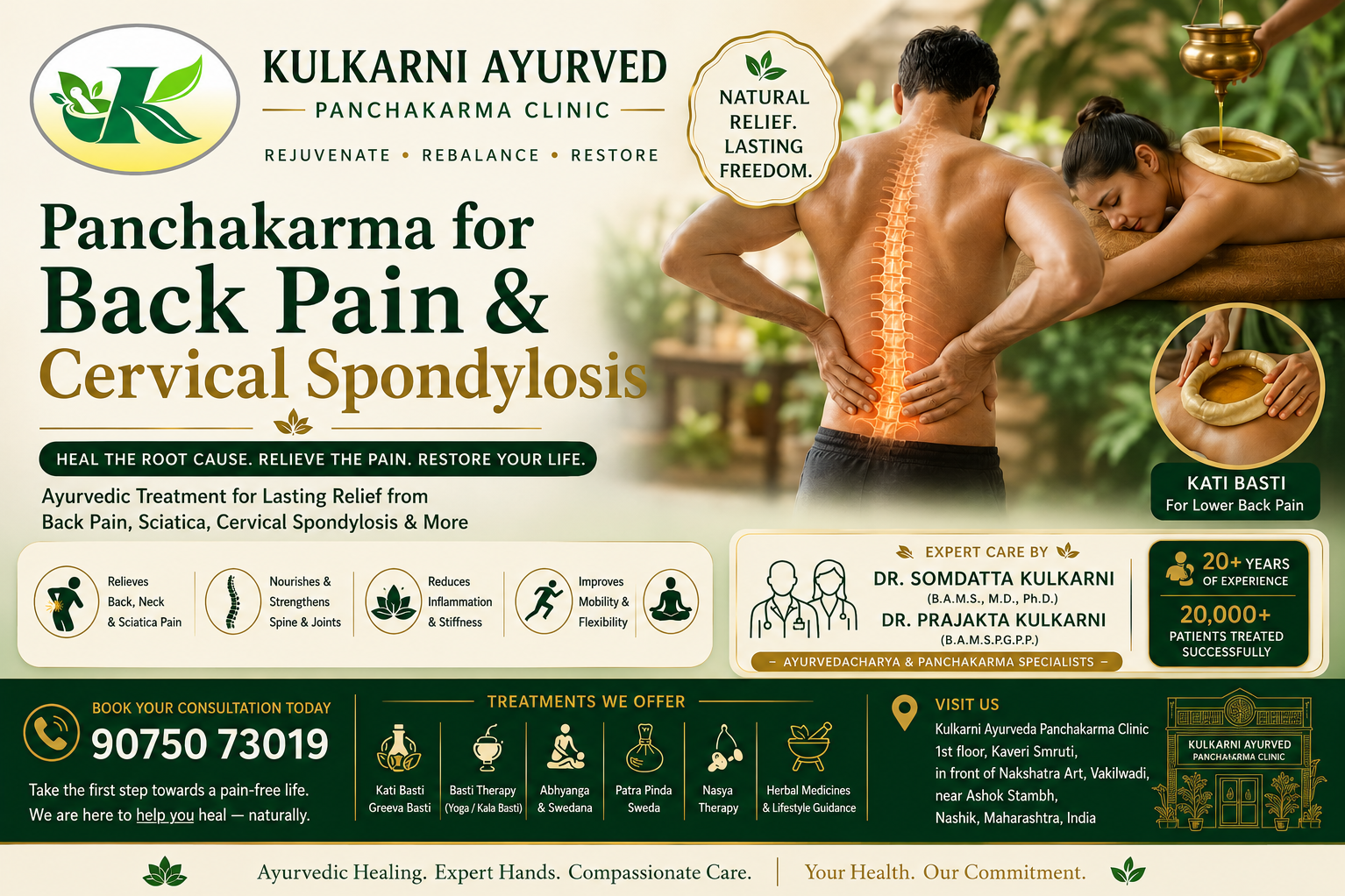
Suffering from chronic back pain, sciatica or cervical spondylosis? Dr. Somdatta & Dr. Prajakta Kulkarni explain how Kati Basti, Greeva Basti & Panchakarma give lasting relief — naturally. Best Panchakarma centre in Nashik. Call 90750 73019. Back pain is one of the most common reasons patients visit KULKARNI AYURVED PANCHAKARMA CLINIC, Nashik. And it is also one of the most rewarding conditions to treat — because when Panchakarma is done correctly, the results are not just relief. They are lasting freedom from pain that patients had accepted as a permanent part of their life. In India today, back pain and cervical spondylosis are reaching epidemic proportions — driven by desk jobs, long hours on phones and computers, poor posture, stress, and a lifestyle that puts enormous strain on the spine. Modern medicine offers painkillers, physiotherapy, and in severe cases — surgery. Each of these has its role. But none of them treats the root cause from an Ayurvedic perspective. In this blog, we will explain exactly how Ayurveda and Panchakarma understand and treat back pain and cervical spondylosis — in simple, clear language — so you can decide if this approach is right for you. 📋 In this article 1. How Ayurveda understands back pain and cervical spondylosis 2. Types of spinal conditions Panchakarma treats 3. Panchakarma treatments for back pain — all options explained 4. Kati Basti — the most effective treatment for lower back pain 5. Greeva Basti — the best treatment for cervical spondylosis 6. The complete Panchakarma protocol for spinal disorders 7. What to expect — results and timeline 8. Yoga and lifestyle advice for spinal health 9. Why choose KULKARNI AYURVED PANCHAKARMA CLINIC, Nashik? 10. Frequently asked questions 1. How Ayurveda understands back pain and cervical spondylosis In Ayurveda, both back pain and cervical spondylosis are primarily Vata disorders. Vata is the energy of movement in the body — it governs the nervous system, the movement of joints, and the health of all musculoskeletal structures. When Vata becomes aggravated — through physical strain, poor posture, stress, erratic eating, cold and dry weather, excessive travel, or overwork — it begins to accumulate in the bones and joints of the spine. Over time, this aggravated Vata erodes the protective qualities of the joint space — the intervertebral discs, the synovial fluid, and the surrounding muscle tissue — leading to: - Stiffness and pain in the lower back (Katigraha / Katishula) - Sciatica — radiating pain down the leg (Gridhrasi) - Neck pain, stiffness, and cervical disc problems (Manyastambha) - Degenerative changes — spondylosis, disc prolapse, bone spurs - Numbness, tingling, and weakness in the limbs 'Vata is the primary cause of all diseases of the bones, joints, and nervous system. When Vata is balanced, the bones are strong, the joints flexible, and the nervous system calm.' — Ashtanga Hridayam The critical difference between Ayurvedic and modern treatment: Modern medicine uses anti-inflammatory drugs and painkillers to suppress the pain signal. This provides temporary relief but does not heal the disc, nourish the joint, or balance the underlying Vata. Panchakarma uses medicated oils and herbal preparations that penetrate deep into the bone and nervous tissue — nourishing, lubricating, and healing at the structural level. 2. Types of spinal conditions Panchakarma treats At KULKARNI AYURVED PANCHAKARMA CLINIC, Nashik, we regularly and successfully treat the following spinal conditions through Panchakarma: Lower back conditions - Lower back pain (Lumbago / Katishula) — acute or chronic, with or without radiation - Lumbar spondylosis — degenerative changes in the lumbar vertebrae - Lumbar disc prolapse (Slipped disc) — L4-L5, L5-S1 level problems - Sciatica (Gridhrasi) — pain radiating from lower back through buttock and down the leg - Sacroiliac joint pain — pain in the region between spine and pelvis - Muscle spasm of the lower back — acute locking of the back Cervical and upper back conditions - Cervical spondylosis — degenerative changes in the cervical vertebrae (C3–C7) - Cervical disc bulge or prolapse — disc pressing on cervical nerve roots - Cervical radiculopathy — numbness, tingling, or weakness in the arm or hand - Neck stiffness and pain (Manyastambha) - Headaches originating from the neck — cervicogenic headache - Shoulder pain from cervical origin Thoracic (mid-back) conditions - Thoracic spondylosis — mid-back stiffness and pain - Intercostal neuralgia — nerve pain around the ribcage - Postural back pain — from prolonged sitting or computer use A reassuring note from our clinic: Many of our patients have been told by orthopaedic surgeons that they 'may need surgery.' After a complete Panchakarma programme at KULKARNI AYURVED PANCHAKARMA CLINIC, Nashik, a significant number of these patients have avoided surgery altogether and returned to normal, pain-free activity. This does not mean surgery is never needed — but Panchakarma deserves to be tried first in most non-emergency cases. 3. Panchakarma treatments for back pain — all options explained ⭐ Kati Basti — the most powerful treatment for lower back pain Warm medicated oil is pooled in a specially made dough ring placed on the lower back. The oil is maintained at a constant warm temperature for 30 to 45 minutes. This is the single most effective Ayurvedic treatment for lumbar conditions. (Full details in Section 4 below.) ⭐ Greeva Basti — the gold standard for cervical spondylosis Warm medicated oil is retained on the cervical spine in a dough dam. Works directly on the degenerated cervical vertebrae, disc spaces, and the surrounding nerve and muscle tissue. (Full details in Section 5 below.) Basti therapy — systemic Vata correction Medicated enema therapy — the most powerful systemic treatment for Vata disorders. Basti corrects the root Vata imbalance that is responsible for the disc and joint degeneration. Without systemic Vata correction, local treatments like Kati and Greeva Basti alone will provide temporary relief that may recur. A course of Yoga Basti (8 sessions) or Kala Basti (16 sessions) is prescribed based on severity. Snehana / Abhyanga — full-body warm medicated oil massage Full-body warm medicated oil massage applied to the entire body as Purvakarma (preparation). Softens and nourishes muscle tissue throughout the body, mobilises Vata from deep tissues, and relaxes the entire musculoskeletal system — including the spine. This is done before every Panchakarma session. Swedana — full-body medicated steam Full-body medicated herbal steam applied to the entire body. Opens channels, reduces stiffness, improves circulation to compressed tissues, and allows the subsequent oil treatments to penetrate more deeply. Essential preparation before Kati Basti or Greeva Basti. Patra Pinda Sweda — herbal bolus fomentation Fresh medicated leaves are heated and applied in a bolus (bundle) to the painful areas. Provides deep heat and anti-inflammatory herbal action directly to the affected vertebrae and muscles. Highly effective for acute muscle spasm and nerve inflammation. Nasya — nasal therapy Medicated oil administered through the nostrils. An essential part of the cervical spondylosis treatment protocol — it works on the upper cervical spine, the nerves supplying the neck and arms, and helps reduce cervicogenic headache. 4. Kati Basti — the most effective treatment for lower back pain Kati Basti is the jewel of Ayurvedic back pain treatment and one of the most frequently performed procedures at KULKARNI AYURVED PANCHAKARMA CLINIC, Nashik. What happens during Kati Basti? 1. Preparation: You lie comfortably face down. The therapist performs full-body Abhyanga (warm medicated oil massage to the entire body) followed by full-body Swedana (medicated steam) to prepare and relax the tissues. 2. Dough ring construction: A ring of black gram (urad dal) dough is placed firmly on the lower back — creating a well-like boundary around the painful area. 3. Oil filling: Warm medicated oil — specifically chosen by the doctor based on your condition — is poured into this ring and maintained at a constant therapeutic temperature. 4. Retention: The warm oil is kept in contact with the lower back for 30 to 45 minutes. The warmth penetrates the skin, the muscles, and reaches the vertebrae and discs below. 5. Post-treatment: The oil is removed, the lower back is given a gentle massage, and you rest for 15 minutes before leaving. Why Kati Basti works so well The intervertebral discs have very poor blood supply — which is why they degenerate and do not heal easily. Kati Basti uses the therapeutic power of sustained warmth and medicated oils to create a localised environment of enhanced circulation, deep tissue nourishment, and anti-inflammatory action. The specific herbs in the medicated oil reduce inflammation around the compressed nerve root, nourish and re-hydrate the dehydrated intervertebral disc, relax the spasming paraspinal muscles, and strengthen the ligaments of the affected vertebrae. How many sessions of Kati Basti are needed? Mild / recent back pain - 7 to 10 sessions, Significant relief, improved flexibility Moderate chronic pain - 14 to 21 sessions, Substantial pain reduction, reduced medicine dependence Severe / disc prolapse - 21 to 30 sessions, Progressive pain relief, functional improvement, avoiding 5. Greeva Basti — the best treatment for cervical spondylosis 'Greeva' means neck. In Greeva Basti, warm medicated oil is retained in a dough dam placed on the cervical spine and neck region — from the base of the skull to the upper thoracic area. What Greeva Basti treats - 1. Cervical spondylosis — degeneration at C3–C7 levels 2. Cervical disc bulge or prolapse 3. Cervical radiculopathy — numbness and tingling in the arm, forearm, or fingers 4. Neck stiffness — inability to turn head fully, morning stiffness 5. Cervicogenic headache — headaches that originate from the neck 6. Shoulder pain from cervical origin 7. Frozen shoulder combined with cervical involvement 8. Neck pain in IT professionals, teachers, and students from prolonged screen exposure How Greeva Basti helps - Greeva Basti directly nourishes the degenerated cervical vertebrae and disc spaces, reduces inflammation and oedema around compressed nerve roots, relaxes the chronically spasming cervical and trapezius muscles, improves circulation to the vertebrobasilar arteries (reducing cervicogenic dizziness and headache), and strengthens the cervical ligaments to reduce instability. 6. The complete Panchakarma protocol for spinal disorders Step 1: Detailed consultation and diagnosis Complete history, Nadi Pariksha (pulse diagnosis), review of MRI / X-ray reports and current medicines. A completely personalised treatment plan is created — including specific therapies, medicated oils, number of sessions, and duration. ⚠️ Important: Always consult a qualified Ayurvedacharya before starting any Panchakarma treatment. At KULKARNI AYURVED PANCHAKARMA CLINIC, Nashik, every patient undergoes a thorough medical assessment — including Nadi Pariksha (pulse diagnosis) — before any treatment begins. Your safety is our first priority. Step 2: Purvakarma — preparation (Days 1 to 5) Full-body Snehana (warm medicated oil massage to the entire body) and full-body Swedana (medicated herbal steam for the whole body) are performed daily. This phase loosens Vata and Ama from deep spinal tissues and prepares the body to respond deeply to the main treatments. Step 3: Pradhanakarma — main treatment (Days 5 to 21) - Daily Kati Basti (for lower back) or Greeva Basti (for cervical) — or both if required - Patra Pinda Sweda or Churna Pinda Sweda over the affected vertebrae - Systemic Basti karma (Yoga Basti or Kala Basti) — to correct Vata at the root - Nasya (for cervical cases and nerve involvement in the upper limbs) - Herbal medicines prescribed after thorough examination of the patient, continued till results are achieved Step 4: Paschatkarma — post-treatment guidelines - - Herbal medicines to be continued at home (until desired results are achieved) - Specific yoga asanas and stretches safe for your spinal condition - Dietary guidelines to keep Vata balanced and support bone health - Postural corrections and ergonomic advice for work and sleep Step 5: Follow-up and maintenance Review consultations at 30 days and 90 days after treatment. For chronic or severe conditions, a second course of Panchakarma after 3 to 6 months may be recommended for maximum benefit. 7. What results can you expect — and when? Timeline & What most patients experience - Days 1 to 3 - Deep relaxation after each session. Mild initial soreness possible as toxins are mobilised — normal and temporary. Days 4 to 7 - Noticeable reduction in morning stiffness. Pain reduces in frequency and intensity. Sleep quality improves significantly. Week 2 - Range of motion in neck or lower back improves visibly. Tingling and numbness in limbs starts to diminish. Days 14 to 21 - Most patients report 50 to 80% reduction in pain. Ability to sit, stand, and walk without discomfort improves significantly. 4 to 8 weeks after treatment - Continued improvement as herbal medicines work systemically. Many patients reduce allopathic pain medicines under their doctor's guidance. 3 to 6 months - Structural benefit in follow-up MRI or X-ray in many patients — improvement in disc height, reduced osteophytes, better disc hydration. 8. Yoga and lifestyle advice for spinal health Beneficial practices - - Walking — 30 minutes of gentle walking daily is the single best exercise for a healthy spine - Gentle yoga — Balasana, Bhujangasana, Setu Bandhasana, Marjariasana — only under proper guidance - Correct sleeping posture — sleep on a firm mattress, on your back or side, never on your stomach - Warm oil self-massage (Abhyanga) — applying warm sesame oil to the back and neck daily before bath - Ergonomic sitting — chair at right height, screen at eye level, lumbar support used - Adequate hydration — keeps intervertebral discs hydrated Things to strictly avoid - - Heavy weight lifting — especially bending and lifting simultaneously - Prolonged sitting without breaks — take a 2-minute standing break every 40 minutes - Looking down at phone for long periods — 'text neck' accelerates cervical degeneration - Sleeping on very soft mattresses or very high pillows - Riding two-wheelers on rough roads without spine support - Exercises like crunches, sit-ups, and deadlifts during the treatment phase - Excessive stress and erratic sleep schedule — major hidden contributors to Vata aggravation 9. Why choose KULKARNI AYURVED PANCHAKARMA CLINIC, Nashik? - 20+ years of dedicated spinal care through Ayurveda — hundreds of patients treated successfully for back pain and cervical spondylosis & cervical spondilitis in Nashik. - Two qualified specialists — Dr. Somdatta Kulkarni (B.A.M.S., M.D., Ph.D) and Dr. Prajakta Kulkarni (B.A.M.S.P.G.P.P.) personally design and supervise every treatment plan - Authentic Panchakarma procedures — Kati Basti, Greeva Basti, and all therapies performed using classical methods and medical-grade herbal oils - Integrative approach — we work alongside your orthopaedic specialist or neurologist - No surgery pressure — we always recommend trying Panchakarma before surgery in non-emergency spinal conditions - Personalised treatment — no two patients receive the same oil or the same protocol - Conveniently located — 1st Floor, Kaeri Smruti, Vakilwadi, Near Ashok Stambh, Nashik 📍 Patients visit us from across Nashik district and beyond — Nashik city, Panchvati, Deolali, Igatpuri, Sinnar, Malegaon, Trimbakeshwar, Nandgaon, and Ozar — as well as from Mumbai, Thane, Kalyan, Pune, Sambhajinagar, and Aliyanagar. as well as from other states cities like like Bengalutu, Ahmedabad, Surat, Vadodara, etc. 10. Frequently asked questions Is Panchakarma better than physiotherapy for back pain? Panchakarma and physiotherapy work at different levels. Physiotherapy strengthens muscles through exercise. Panchakarma heals the deeper structures — the disc, the vertebral bone, the nerve — through medicated oils and internal herbal medicines. For conditions involving disc degeneration, nerve compression, or structural bone changes, Panchakarma offers direct nourishment and healing at the tissue level that physiotherapy cannot. I have been advised surgery for a slipped disc. Should I try Panchakarma first? In most non-emergency cases of disc prolapse — where there is no severe neurological deficit (muscle weakness or loss of bladder or bowel control) — a proper Panchakarma programme is absolutely worth trying before agreeing to surgery. A significant number of our patients advised surgery have achieved complete or near-complete recovery through Panchakarma. Please share your MRI report with our doctor so we can assess your case individually. How is Kati Basti different from a hot pack or heat pad? A hot pack simply applies surface heat — it relaxes surface muscles temporarily. Kati Basti uses specifically prescribed medicated oil whose active herbal constituents are absorbed through the skin into the deeper tissues — including the vertebrae, discs, and nerve roots — over 30 to 45 minutes of sustained warm contact. The therapeutic effect is completely different. Can I get Kati Basti and Greeva Basti done on the same day? Yes, this is commonly done for patients who have both lower back and cervical involvement. Our doctors regularly prescribe combined sessions of Kati Basti and Greeva Basti in the same visit. Can I get Kati Basti and Greeva Basti done on the same day? Yes, this is commonly done for patients who have both lower back and cervical involvement. Our doctors regularly prescribe combined sessions of Kati Basti and Greeva Basti in the same visit. I have been taking pain medicines for years. Can I stop them after Panchakarma? Many patients successfully reduce or discontinue their pain medicines after a complete Panchakarma programme — but this must always be done gradually and under the supervision of your prescribing doctor. We never advise abruptly stopping any prescribed medicine. Is Panchakarma safe for elderly patients with back pain? Yes, Panchakarma is safe and highly beneficial for elderly patients. Aging is a Vata-dominant process — which is exactly why back pain and cervical spondylosis increase with age. Kati Basti and Greeva Basti are gentle, non-invasive procedures regularly performed on patients in their 60s, 70s, and beyond at our clinic with complete safety and excellent results. How long does pain relief from Kati Basti last? Patients who complete a full course (14 to 21 sessions) along with systemic Basti karma and follow the post-treatment protocol typically experience sustained relief for 6 months to 2 years or more. Annual maintenance sessions — especially during monsoon — help prevent recurrence. What is the cost of Kati Basti and Greeva Basti in Nashik? Please call us at 90750 73019 or visit KULKARNI AYURVED PANCHAKARMA CLINIC at 1st Floor, Kaveri Smruti, Vakilwadi, Near Ashok Stambh, Nashik for a detailed consultation and transparent cost estimate. We explain everything clearly before any treatment begins. Can I come for Kati Basti during pregnancy? Certain modifications of local back treatments can be done safely in pregnancy — but this requires careful individual assessment. Systemic Basti is generally not performed during pregnancy. Please consult our doctors directly at 90750 73019 so we can advise the safest treatment for your specific condition and trimester. Don't let back pain define your life Kati Basti, Greeva Basti, and Panchakarma have been healing spinal disorders naturally for 5, 000 years. Our specialists are ready to help you find lasting relief — without painkillers, without surgery. 📞 90750 73019 | 💬 WhatsApp: 90750 73019 Free initial consultation · Personalised treatment · 20+ years experience 🏥 KULKARNI AYURVED PANCHAKARMA CLINIC 📍 1st Floor, Kaveri Smruti, Near Nakshatra Art, Vakilwadi, Near Ashok Stambh, Nashik, Maharashtra 📞 90750 73019 💬 WhatsApp: 90750 73019 👩⚕️ Our specialists Dr. Somdatta Kulkarni B.A.M.S., M.D., Ph.D Panchakarma Specialist | 20+ Years Dr. Prajakta Kulkarni B.A.M.S.P.G.P.P. Panchakarma Specialist | 20+ Years